
Reviewed · CHIVA BUS TOURS
City Tour in Chiva through the City of Cartagena
Cartagena’s chiva bus gives this sightseeing tour its local flavor. You ride a colorful, open-sided bus through the city, stop for photographs, visit the massive San Felipe de Barajas fortress, and finish on foot inside the old walls. It is a useful first look at Cartagena, especially if you want the main landmarks without arranging several separate rides.
I like two things in particular: the fort admission is included, and the guides often make a real effort with English, even when most of the group speaks Spanish. I also like the mix of bay views, monuments, and a walking tour through the old city. The main drawback is heat. The chiva has no air-conditioning or fans, and some departures spend a long time collecting passengers before the sightseeing truly begins.
Key points to know before booking
- San Felipe de Barajas is the tour’s strongest historical stop, with about 90 minutes for entry and a guided visit.
- The open-sided chiva is fun and distinctive, but it can be hot, crowded, and requires climbing about three steps to board.
- English support varies, though guides including César, Herman, Freddie, and Martín have made strong efforts to translate.
- The tour covers Cartagena’s essential first-visit sights, from the bay and Old Shoes to the Walled City and Clock Tower.
- A shopping stop may be added, including an emerald or jewelry store, so not every minute is spent at the advertised monuments.
- The $35 price is fair for a broad introduction, since transport, guide service, the chiva ride, and fort entry are included.
A four-hour introduction to Cartagena by chiva
This is a sightseeing sampler rather than a slow, focused history walk. In roughly four hours, you see major landmarks outside the old walls, enter one of Colombia’s most important fortresses, and then walk through Cartagena’s colonial center.
The order can feel less tidy than the printed route suggests. Pickups may take place around the beach hotel district, and one account describes spending about an hour and a half collecting other groups before the main sightseeing got underway. If you are already near the Walled City, you might find the early circling frustrating.
Still, the format has a clear purpose. You get a broad view of Cartagena first, then spend time at San Felipe and in the old center. For a first day, that can help you decide where you want to return for a longer visit.
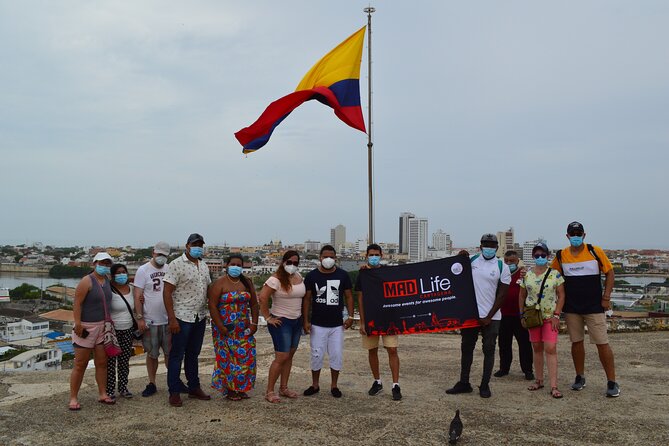
The group may reach as many as 30 people. That keeps the price down, but it also means the bus can feel crowded and the guide must work hard to keep everyone together. Freddie was praised for keeping a large group on schedule, while Martín, César, and Herman were singled out for their history explanations and attention to English-speaking passengers.
More Chiva Bus Tours in Cartagena
- Party Bus Tour
★ 4.5 · 77 reviews - Cartagena: Funny PartyBus with dance floor and good music!
★ 4.3 · 19 reviews - Chiva Rumbera: The party on wheels you should experience
★ 4.5 · 13 reviews
Riding the open-sided chiva
The chiva is a traditional Colombian bus adapted for sightseeing. Its colorful look and open sides make the ride part of the attraction, not merely a way to get from one stop to the next. You can take photographs as Cartagena passes by, and the vehicle gives the outing a more festive feel than a standard minibus.
The tradeoff is comfort. There is no air-conditioning or fan, and Cartagena’s heat can be intense. Several people found it hard to enjoy the ride fully because of the temperature. Wear light clothing, bring sun protection, and carry water. Bottled water and soda are not included, so you should plan to buy your own.
Boarding requires climbing about three rungs of a ladder. That matters if you have limited mobility or certain physical restrictions. One person also felt the bus should be made more accessible. The tour information says most people can participate, but it does not promise wheelchair accessibility.
The bus may also feel overly full. If you prefer quiet transport, cool air, and plenty of personal space, a private vehicle would suit you better. If you see the chiva as part of the Cartagena experience and can handle the heat, it adds a memorable local touch.
Cartagena Bay and the first city views
The bay is an appropriate opening scene. Cartagena’s natural harbor helped make the city a major commercial gateway during the Spanish colonial period, and the water remains one of the best ways to understand the city’s location.
You’ll see the sea, the city walls, and the urban waterfront, with the sun often adding a strong backdrop for photographs. The stop lasts about 15 minutes and is mainly for views and orientation, not a long history talk on foot.
The route also passes the Convention Center and the internal bay. Depending on the exact timing and traffic, you may see more from the bus than from a formal stop. I would keep your camera ready, but do not expect a leisurely waterfront stroll.
Cartagena letters and the Old Shoes monument
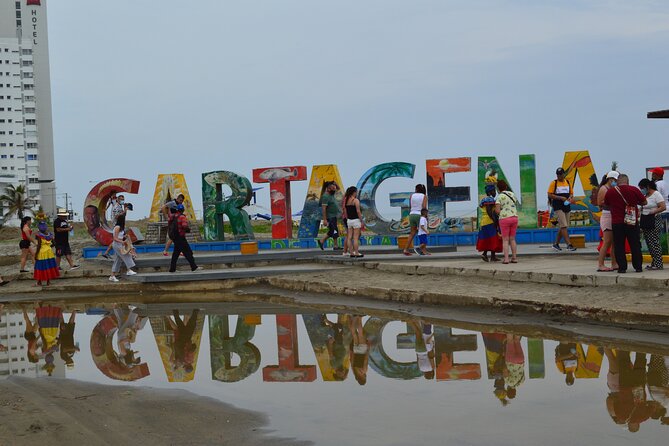
A stop at the Cartagena letters offers an easy photo opportunity. The monument is made from recycled material and rises about 2.40 to 2.60 meters high. It is the kind of cheerful travel photograph that works well early in a visit, before you have found your own favorite corners of the city.
The exact stop is included in the opening description, though it is not listed with its own numbered time. The schedule may therefore be flexible. You might have enough time for photographs, but the guide controls the pace so the group can reach the fort and later walking tour on time.
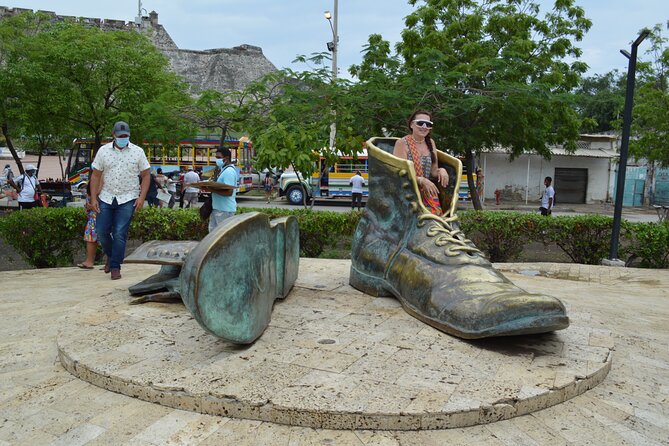
The Monument to the Old Shoes receives about 20 minutes. It honors a major Cartagena poet and uses a pair of worn shoes as a symbol of affection, belonging, humble origins, and city pride. The sculpture is more than a quick photo prop. It gives your guide a chance to explain how local identity can be expressed through a simple public monument.
Street vendors may approach you at stops and near the old city. That is part of the setting, but it can feel persistent. A friendly, firm no thank you is usually enough. Keep your valuables secure and stay aware while taking photographs.
More City Tours in Cartagena
- Cartagena: City Sightseeing Hop-On Hop-Off Bus Tour & Extras
★ 3.9 · 681 reviews - Cartagena: Panoramic City Tour, Monuments, Walls, Castle
★ 4.0 · 636 reviews - Cartagena: BILINGUAL CITYTOUR + SAN FELIPE CASTLE & Old city
★ 4.2 · 387 reviews - Cartagena: Walled City and Getsemani Shared Walking Tour
★ 4.5 · 352 reviews
San Felipe de Barajas, the tour’s main attraction
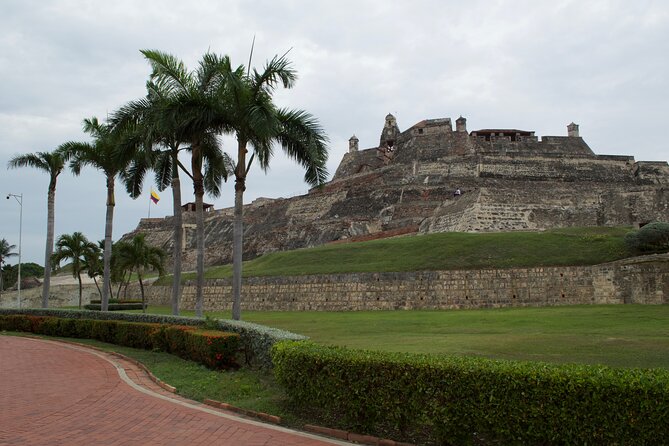
The visit to Castillo de San Felipe de Barajas is where the $35 price begins to make real sense. Admission is included, and the tour allows about 90 minutes for the fortress with a guide.
Built in 1657 during the Spanish colonial period, the fort sits on San Lázaro Hill. Its position helped defend Cartagena from attacks by sea and land. The fortress faced repeated assaults from English and French forces, and the French commander Baron de Pointis captured it in 1697.
You can expect the guide to place the fort within Cartagena’s military story rather than simply point out walls and viewpoints. The site is considered one of Colombia’s seven wonders, and its size gives you a much stronger sense of the city’s defensive system than a photograph can provide.
The fort is also the most physically demanding part of the outing. The supplied information does not give a detailed accessibility assessment, so anyone with mobility concerns should ask before booking. Heat can build quickly around the stone structures, and comfortable shoes are important.
Ninety minutes is a useful amount of time. It gives you more than a hurried photo stop, though it is not enough for every corner of the complex. If San Felipe is high on your list, this guided visit is a strong reason to choose the tour instead of exploring only the Walled City.
India Catalina and the story behind the statue
The route passes the Monument to India Catalina before reaching the historic center. The statue honors Catalina, who was born in nearby Galerazamba and was later taken to Santo Domingo as a slave. Pedro de Heredia brought her to Cartagena in 1533 to serve as an interpreter.
Her story is tied to the beginnings of Spanish settlement and the mixing of cultures in the Cartagena region. It also deserves careful treatment. The monument can be presented as a symbol of American roots, but Catalina’s life reflects coercion as well as cultural exchange.
The stop is described as a pass-by rather than a long visit. Listen closely as the guide explains the statue, since the bus sound system may not always be easy to hear. One person found the audio quality poor enough that parts of the explanation were lost during the moving portions of the tour.
Walking into the Walled City
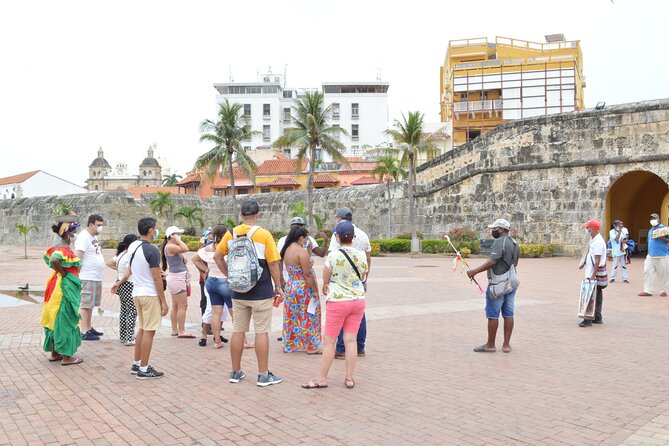
The final walking tour takes place inside Cartagena’s historic center, recognized by UNESCO as a World Heritage site since 1984. This is the part of the experience where the pace slows and the city’s details become easier to appreciate.
You may see churches, convents, monasteries, plazas, colonial houses, palaces, and other old buildings. The guide provides the historical frame, while you get time to look at doors, balconies, streets, and public squares. The official walking portion lasts about 30 minutes, so treat it as an introduction rather than a complete old-city tour.
The center also has shops and higher-end brands. A jewelry or emerald store stop may be included, sometimes with a sales presentation. One account describes this as an unwelcome use of time, while another appreciated the air-conditioned break. You are not required to buy anything, and you should feel free to browse briefly or make your position clear.
The Clock Tower, or Puerta del Reloj, is one of the best-known entrances to the old city. It was first called Boca del Puente and served as the main gateway through the walls. The side arches once held a chapel and an armament room, and a republican-style clock tower was added in 1888.
The scheduled visit lasts about 10 minutes. That is enough for photographs and a short explanation, but not a full exploration of the structure. Because the Clock Tower sits at a central entrance, it also helps you understand the boundary between modern Cartagena and the old walled quarter.
Language, guiding, and group rhythm
The tour is promoted with a certified guide, but English service is not guaranteed in the same way at every departure. This is the most important point for English-speaking customers.
César was praised for giving detailed explanations and paying close attention to the small number of English speakers in his group. Herman was also appreciated for combining the main stops with extra details, including a chocolate factory visit and a sample of chocolate beer on one departure. Freddie kept a large group moving while explaining Cartagena’s past, and Martín was repeatedly described as friendly, patient, and entertaining.
Other English-speaking customers needed to remind the guide to translate, and one person found the tour unsuitable because the guide spoke only Spanish. I would confirm the language when booking and again before the day of the tour. If you understand Spanish, the experience is more straightforward. If you do not, the quality may depend heavily on the guide assigned that day.
The sound system is another variable. Explanations may be harder to catch on the moving bus, especially with street noise. Stand or sit where you can hear the guide, and do not hesitate to ask for a repeat.
Price, comfort, and who gets good value
At $35 per person, this is a sensible price for a broad first look at Cartagena. You receive private transportation, a chiva ride, a guide, and admission to San Felipe de Barajas. Paying separately for transport and the fortress could quickly reduce the savings of planning the same route yourself.
The value is strongest if you want convenience and orientation. You can see several major sights in one half-day and avoid figuring out local transport between them. It is also a good fit for families and first-time visitors who want a simple overview before exploring independently.
The value weakens if you dislike group schedules, sales stops, hot vehicles, or repeated pickups. You may prefer to visit the Walled City on foot at your own pace and arrange a separate fort visit. The tour is also less appealing if your main aim is a detailed, uninterrupted history lesson in English.
The experience is generally suitable for most participants, and service animals are allowed. It is near public transportation, though the exact pickup arrangements should be confirmed. Free cancellation is available up to 24 hours before the start time. After that point, the amount paid is not refunded, and changes are not accepted within 24 hours.
Should you book the Cartagena chiva tour?
Book it if you want a cheerful, efficient introduction to Cartagena and you value the included San Felipe entry. The best parts are the fortress, the city overview, and the chance to hear local stories from guides such as Martín, César, Herman, or Freddie.
Skip it if you need air-conditioning, guaranteed English, easy boarding, or a fully flexible schedule. If you do book, wear walking shoes, bring water, expect sun, and confirm the tour language. With those limits in mind, this is a good first-day choice for seeing the city’s essential sights without paying for a much more expensive private excursion.
FAQ
How long is the Cartagena chiva tour?
The experience lasts approximately four hours.
How much does the tour cost?
The listed price is $35 per person.
Is admission to San Felipe de Barajas included?
Yes. Entrance to Castillo de San Felipe de Barajas is included, along with a guided visit of about 90 minutes.
What transportation is used?
The tour includes private transportation and transportation in a chiva bus.
Is a tour guide included?
Yes. A certified tour guide is included.
Does the tour visit the Walled City?
Yes. The experience ends with a walking tour through Cartagena’s Historic Center, including the Walled City and a visit to the Clock Tower area.
Is English guaranteed on the tour?
The supplied information does not guarantee English service. Some guides have translated carefully for English-speaking participants, while at least one departure was conducted only in Spanish. Confirm the language before booking.
Is the chiva air-conditioned?
No. The chiva has no air-conditioning or fans, so expect hot conditions.
Are food, water, or soda included?
No. Bottled water and soda are not included.
Can I cancel for a full refund?
Yes, if you cancel at least 24 hours before the experience start time. Cancellations made less than 24 hours in advance are not refunded, and changes are not accepted within that period.
Just added around Cartagena
- Exotic Yacht – Tour through the bay of Cartagena★ 3.7 · 4 reviews
- White Night Boat Party: Dinner Buffet, Dancing and Open Bar★ 4.6 · 3 reviews
- Volcan del Totumo + Playa + Piscina★ 4.7 · 4 reviews
- cartagena: Mucura and Santa Cruz Islands Tour spectacular★ 4.0 · 12 reviews
- Enjoy the totumo volcano from cartagena + snack★ 4.0 · 11 reviews
- 5 islands tour to rosario Islands with snorkeling activity!★ 4.5 · 36 reviews
- Romantic Date Night in the Bay of Cartagena★ 5.0 · 47 reviews
- Totumo volcano tour + snack★ 4.5 · 44 reviews
Chiva Bus Tours, compared.
City Tour Medellin with a Chiva or a thematic van
Read our review →

Chiva Private Cultural Tour with Audio Guide in Buga
Read our review →

Rumbero Party Bus with all the beer you can drink
Read our review →
Explore with a city tour aboard a typical “chiva”.
Read our review →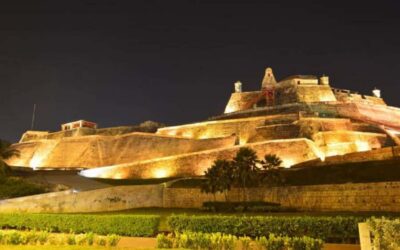
Chiva Rumbera: The party on wheels you should experience
Read our review →Browse the lists this tour appears in