
Reviewed · WALLED CITY & GETSEMANí TOURS
Shared Old Cartagena & Getsemani Tour with Wireless System
Cartagena’s best introduction may be the walk from grand colonial plazas to the gritty, colorful streets of Getsemaní. This $13 shared tour links the Walled City with the neighborhood where independence, street art, music, and daily life still meet. I like the clear route through major sights, and I like the wireless audio system, which lets you look around or take photos without losing the guide’s thread.
The main drawback is pace. You are told to expect about two hours and roughly 8 kilometers of walking, while the route includes many stops. That means some explanations may be brief, and the heat can catch up with you. Wear good shoes, carry water, and arrive ready to keep moving.
Key points at a glance
- A full old-town-to-Getsemaní route: Start near Santo Domingo Square and finish in Getsemaní, rather than seeing only the postcard center.
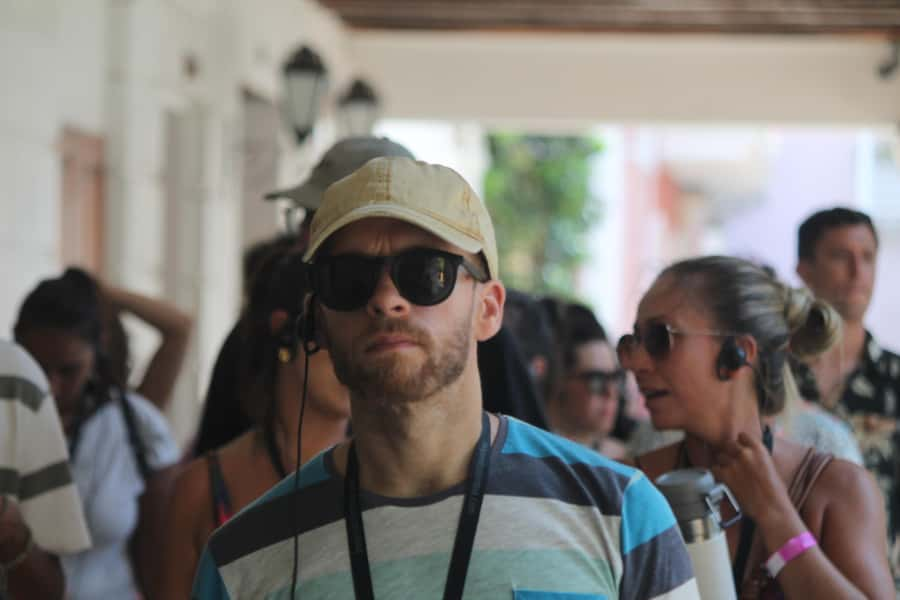
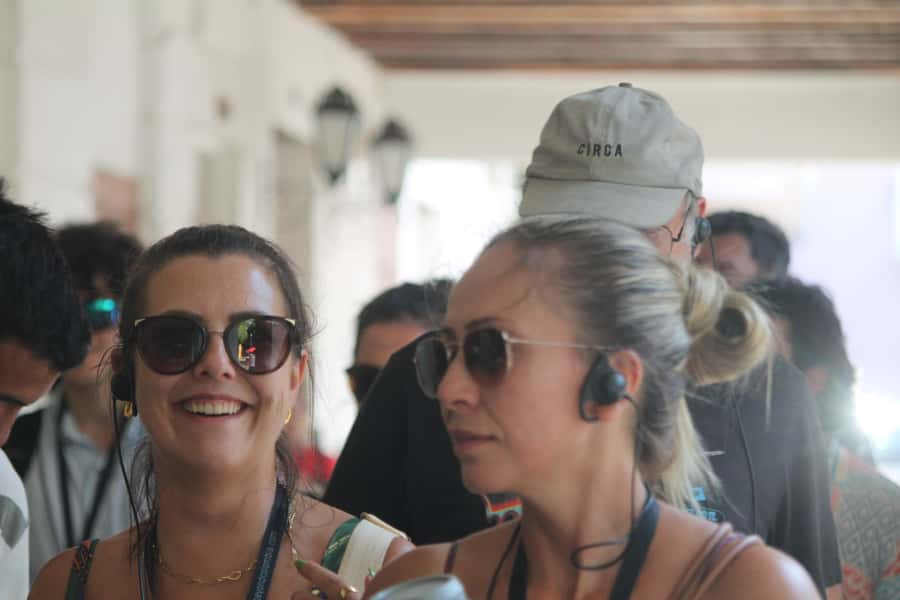
- Wireless receivers included: You can hear the guide in crowded plazas and busy streets while staying free to take photos.
- Strong historical range: Hear about pirates, battles, the Inquisition, independence, architecture, and Afro-Caribbean identity.
- Clear meeting point: Find the red Beyond Colombia umbrellas beside Botero’s Gertrudis sculpture in Santo Domingo Square.
- Good value at $13: The fee covers a certified guide, the walking route, audio equipment, and local recommendations, but not food, drinks, transport, or paid entries.
- A demanding walk: The route is not suitable for children under 6 or people over 65, and comfortable shoes are essential.
From Santo Domingo Square into Cartagena’s story
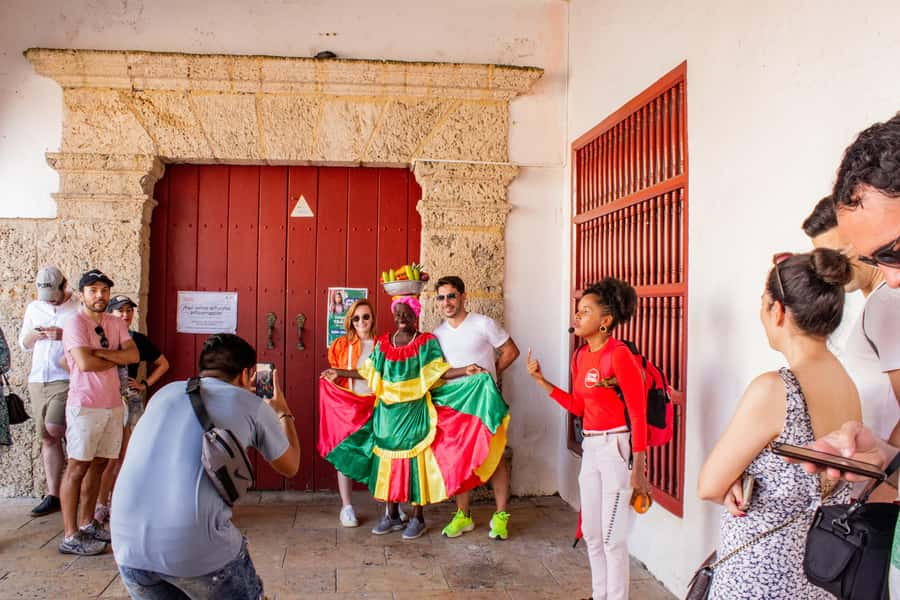
Meet at Santo Domingo Square, beside the large Gertrudis sculpture by Fernando Botero. Look for the red Beyond Colombia umbrellas, and arrive about five minutes early so the staff can fit you with the wireless receiver.
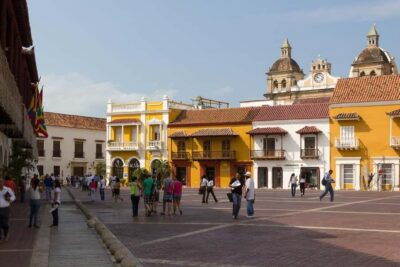
The starting point is useful because Santo Domingo Square puts you right in the middle of Cartagena’s old center. It has colonial buildings, outdoor activity, art, and plenty of people passing through. From here, your guide can explain how Cartagena’s public squares worked as places for religion, trade, government, celebration, and control.
This is a shared walk, not a private tour. I see that as a plus if you enjoy meeting people and want a low-cost introduction to the city. It also means the pace and questions will be shaped by the group. If you want to stop for long photo sessions or ask about every building, this may feel brisk.
The tour is offered in English or Spanish, with a live guide and matching audio support. Louis Carlos is one guide associated with the experience, and a verified booking specifically praises him for his command of the subject and strong guiding. Guide assignments can vary, so you should not assume he will lead every departure.
More Shared Tours in Cartagena
- Cartagena: Historic Center and Getsemaní Shared Walking Tour
★ 4.9 · 2,716 reviews - Cartagena: Walled City and Getsemani Shared Walking Tour
★ 4.5 · 352 reviews - Gabriel Garcia Marquez Shared Tour: the magical Cartagena
★ 5.0 · 82 reviews
Plaza de la Proclamación and Plaza de Bolívar
The first major stretch takes you through Plaza de la Proclamación and Plaza de Bolívar. These squares help you read Cartagena as more than a collection of pretty facades.
Plaza de la Proclamación is tied to civic life and the city’s political story. In this part of the route, the guide connects the buildings and open space with the people and events that shaped Cartagena. Look up as you walk. Wooden balconies, painted walls, and flower-filled facades are part of the appeal, but the guide’s context helps you notice why the architecture looks the way it does.
Plaza de Bolívar offers another change in mood. It is a formal public square with shade, monuments, and nearby historic buildings. The route uses it to explain Cartagena’s colonial order, religious influence, and political past.
I like having both plazas early in the walk. You get a quick lesson in how the city’s center is organized before moving on to churches and commercial streets. The limitation is that a short tour cannot give every building a full explanation, so pay attention to the guide’s main themes rather than trying to memorize every date.
San Pedro Claver and the colonial center
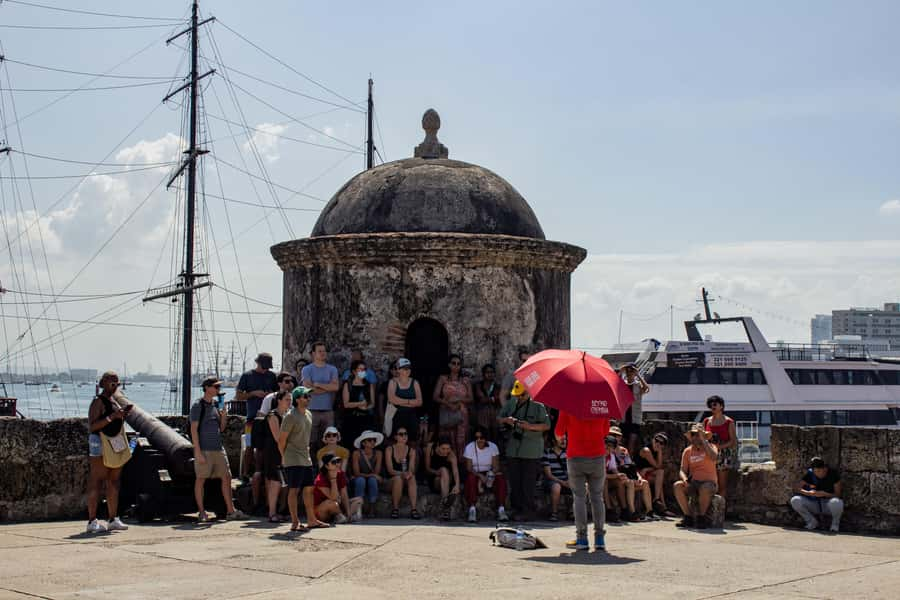
The stop at the Santuario de San Pedro Claver brings a religious and human dimension to the route. The church is one of the old center’s major landmarks, and the guide discusses the forces behind Cartagena’s colonial society, including the difficult subjects that polite sightseeing can leave out.
The tour also includes stories connected to the Inquisition, slavery, battles, and the people who defended the city. That range matters. Cartagena can look like a cheerful Caribbean stage set if you only focus on balconies and bright paint. The guide’s job here is to show how power, faith, trade, and human suffering all shaped the same streets.
You do not pay for entrance tickets as part of this walk, and the group will not be taken to places with surprise charges. Treat this as an outside-focused city tour unless the guide tells you otherwise. If you want extended time inside churches or museums, plan a separate visit.
Plaza de la Aduana, Plaza de los Coches, and the Clock Tower
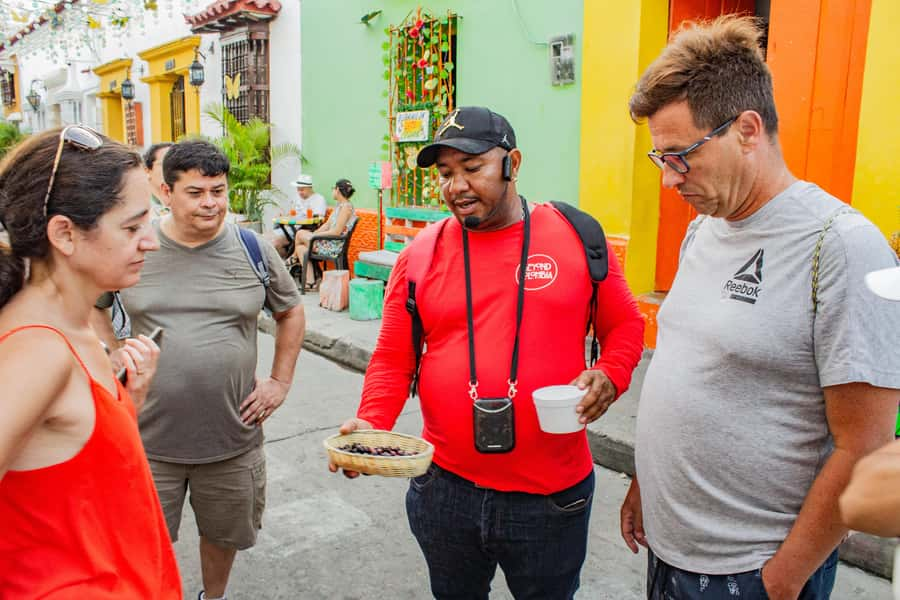
The route then moves through Plaza de la Aduana and Plaza de los Coches, two key spaces near the old commercial entrance. These plazas help explain Cartagena’s role as a port and a fortified Spanish city.
Plaza de la Aduana has a broad, official feel. It was tied to customs and trade, so it is a good place to connect the attractive old buildings with the money and goods that passed through Cartagena. Plaza de los Coches is closer to the city’s famous entrance and has a more active street atmosphere.
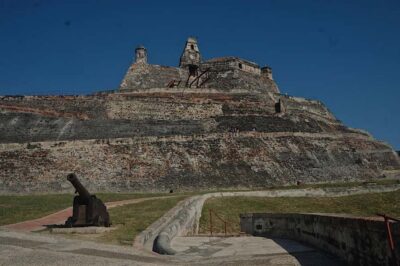
The Clock Tower Monument, or Torre del Reloj, is the classic arrival point into the Walled City. It is one of Cartagena’s most recognizable sights and a natural place for photographs. Your guide uses it to talk about the city walls, pirate attacks, defense systems, and the way the old center controlled access.
This is one of the strongest parts of the route for a first visit. You see the grand entrance, hear why the walls mattered, and get a sense of how Cartagena presented itself to merchants, soldiers, and enemies. It can also be crowded, which is exactly where the wireless system helps. You can stand slightly to one side for a picture and still hear the explanation.
More walks through the walled city and Getsemani:
- Cartagena: BILINGUAL CITYTOUR + SAN FELIPE CASTLE & Old city
★ 4.2 · 387 reviews - Cartagena: Walled City & Getsemani Private Tour
★ 4.8 · 107 reviews - Walled City, Getsemani San Felipe Castle Cartagena City Tour
★ 4.7 · 91 reviews - Walking Tour Cartagena Old City with Gold Museum and Plaza de Bolivar
★ 4.5 · 28 reviews
Camellón de los Mártires and Parque Centenario
After the Clock Tower, the walk crosses Camellón de los Mártires and reaches Parque Centenario. This section helps bridge the polished Walled City and the more everyday energy of Getsemaní.
Camellón de los Mártires carries the memory of people connected to Cartagena’s struggle for independence. The name itself invites a discussion of sacrifice and political change. Rather than treating independence as a single heroic moment, the guide can show how it affected streets, neighborhoods, and local identity.
Parque Centenario is a useful resting point and a change of scenery. You get some breathing room after the dense streets of the old center, though do not count on a long break. The supplied guidance says the walk includes resting stops, but the whole experience remains active and covers significant ground.
I would use this point to refill your water bottle if you can. Cartagena’s heat, humidity, and stone streets make the 8-kilometer route more tiring than the two-hour duration sounds on paper. Comfortable clothes matter more than dressing up for photographs.
Entering Getsemaní through Calle de la Magdalena
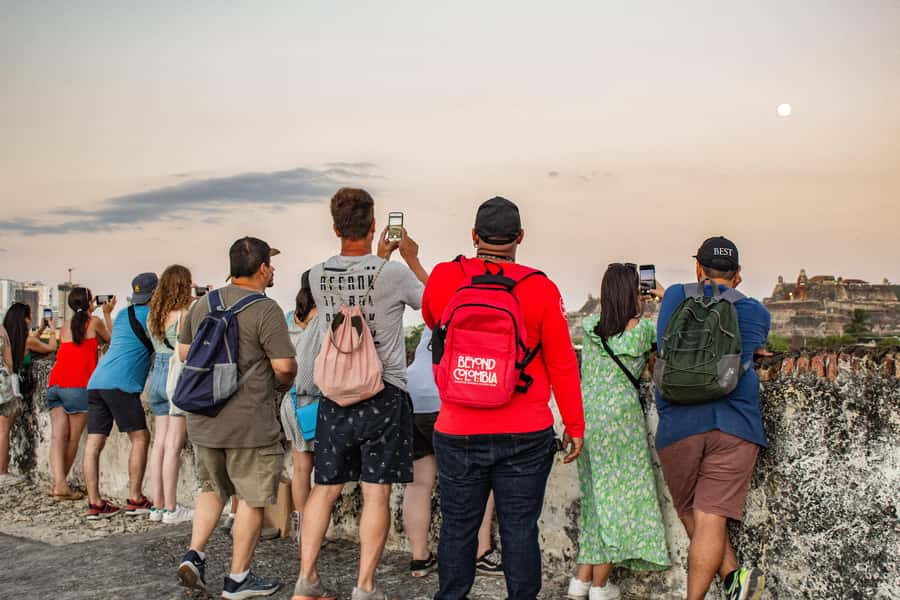
Calle de la Magdalena and Calle del Guerrero lead you toward Getsemaní. Here the tour changes from a formal colonial presentation to a neighborhood walk shaped by murals, music, local commerce, and daily routines.
Getsemaní is described as the heart of the people, and the phrase fits the purpose of this section. The guide focuses on the neighborhood’s role in independence and its Afro-Caribbean character. You see narrower streets, colorful homes, public art, and corners that feel less arranged for sightseeing.
This part is valuable because it gives you a contrast. The Walled City presents Cartagena through fortifications, churches, grand squares, and official buildings. Getsemaní shows a city shaped by residents, community pride, creativity, and persistence.
You should keep your belongings close here and throughout the route. The guidance is direct: crowded areas require basic city awareness. Keep your phone secure, do not leave a bag open, and avoid getting so absorbed in a photo that you lose track of your group.
Plaza de la Trinidad and the streets of local life
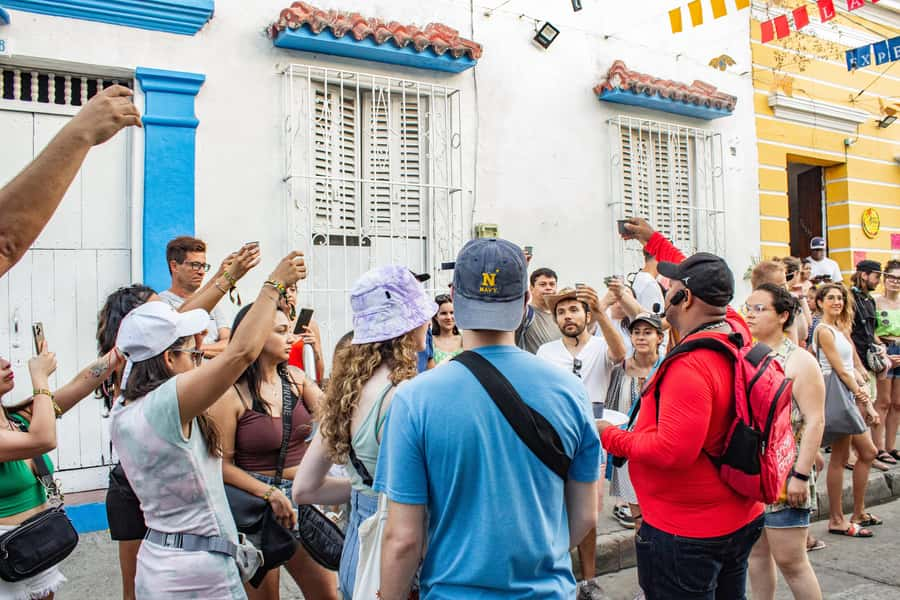
Plaza de la Trinidad is the social center of Getsemaní and one of the most memorable stops on the walk. It is a place to pause and watch neighborhood life unfold around a historic church and public square.
The guide uses the plaza to explain Getsemaní’s role in Cartagena’s past and present. This is where the tour’s themes of independence, community, music, and local identity come together. You are not just looking at old buildings. You are seeing how a historic neighborhood remains part of the city’s daily life.
From there, the walk continues through Callejón Ancho and toward Calle de la Sierpe. The street art becomes a major focus. Murals reflect resistance, pride, dreams, and Afro-Caribbean culture. Their colors make excellent photographs, but the guide’s interpretation is the useful part. You learn to see public art as a statement about identity, not just decoration.
The exact balance between explanation and photo time depends on the group. I would take quick pictures as you walk and save longer photo stops for after the tour. The audio receiver makes that easier, since you do not need to stand shoulder to shoulder with the guide.
What the wireless system adds
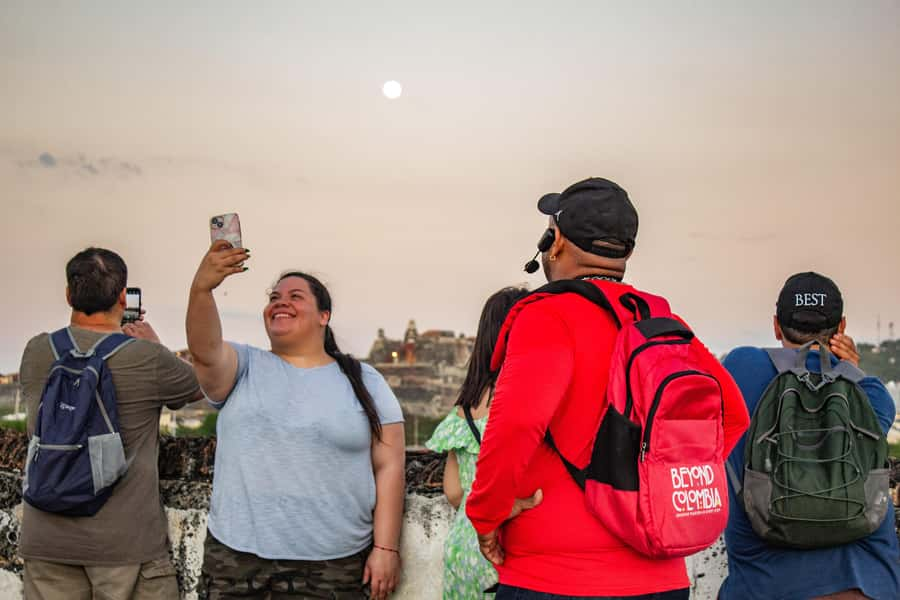
The receiver is not a fancy extra. In a city tour, it solves a real problem. Cartagena’s plazas and narrow streets can be noisy, and a normal speaking voice disappears quickly when the group spreads out.
With the system, you can hear the guide while looking at a balcony, checking a mural, or stepping aside for other pedestrians. It also reduces the need for everyone to crowd around the guide. That makes the walk feel less like a moving huddle.
The equipment works in English or Spanish, and you receive it before departure. Do not record the tour. Video and audio recording are not allowed, so use the system for listening and keep your phone available for photos only.
Is $13 good value?
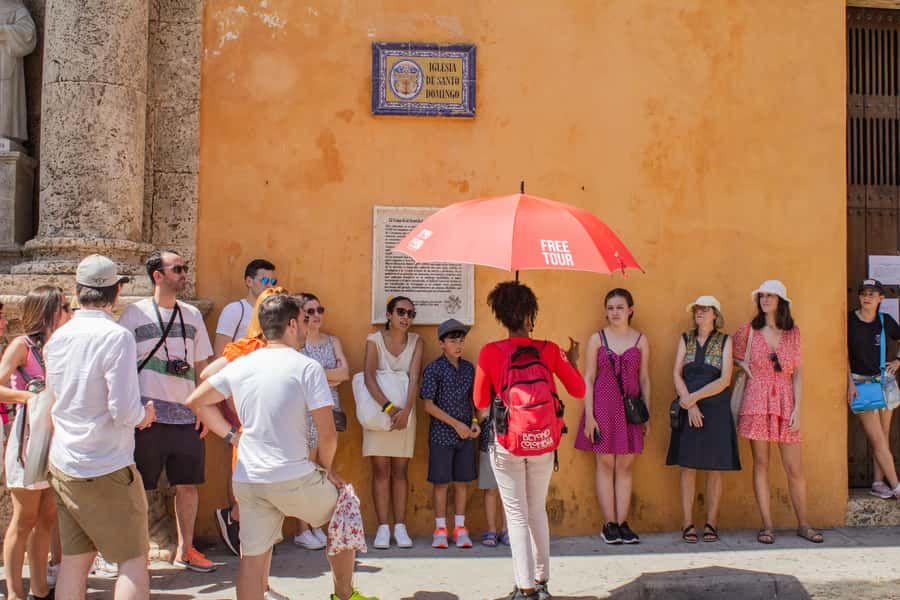
At $13 per person, I consider this a strong first-day purchase if you want orientation and history without paying for a private guide. You get a certified guide, the wireless receiver, a route through both major districts, practical local suggestions, and access to partner discounts through the wristband given at the end.
The value is highest if you are new to Cartagena and want someone to connect places that might otherwise seem unrelated. You see the old center’s major squares, the Clock Tower, the route toward Getsemaní, Plaza de la Trinidad, and street art in one outing.
The price does not include drinks, food, souvenirs, hotel transport, or paid entrances. You walk the full route, so there is no vehicle between stops. If you want a slow church tour, a food tour, or a private experience, you will need something else.
The advertised duration is two hours, but the route description includes many separate stops and about 8 kilometers of walking. I would confirm the departure time when booking and expect a brisk outing. The detailed stop durations shown for individual locations add up to much more than two hours, so treat those figures as indications of places covered rather than promises of twenty minutes at every stop.
Who should book this Cartagena walk?
I would recommend it to first-time visitors who want the city’s main historical frame before exploring alone. It also suits anyone who enjoys public art, local neighborhoods, and a guide who connects the colonial past with present-day culture.
It is a good match if you like walking, can handle warm weather, and prefer a practical overview to a slow, formal lecture. The English and Spanish options make it easy to choose the language you follow best.
I would be more cautious if you have limited walking ability, dislike group tours, need frequent long breaks, or are visiting with a child under 6. The activity is also marked as unsuitable for people over 65. That restriction may feel broad, since fitness varies widely, but the route length and heat are real considerations.
Bring water, wear comfortable shoes, and arrive five minutes early. You can cancel up to 24 hours before the start for a full refund, and the reserve-now, pay-later option keeps your plans flexible.
Should you book it?
Book this tour if you want an inexpensive, well-organized introduction that covers both Cartagena’s famous center and its more local-facing side. The best reasons are the Walled City to Getsemaní route, the wireless audio, and the chance to hear about history, street art, and neighborhood identity in one walk.
Skip it if you want a relaxed pace or a private guide. For most first-time visitors who can manage the distance, $13 is a sensible way to get your bearings before returning to the places that deserve more time.
FAQ
Where does the tour start?
It starts at Santo Domingo Square beside Botero’s Gertrudis sculpture. Look for the red Beyond Colombia umbrellas.
Where does the tour finish?
It finishes at Av. Pedregal #27-137 a 27-1 in Getsemaní, Cartagena de Indias.
How long is the tour?
The advertised duration is two hours. The walking route covers about 8 kilometers and includes several short stops.
What languages are available?
The live guide and audio support are available in English and Spanish.
Is transportation included?
No. You walk between the stops, and transportation to and from your hotel is not included.
What should I bring?
Bring comfortable shoes, comfortable clothes, and water or another drink. Keep your belongings close in crowded areas.
Just added around Cartagena
- Exotic Yacht – Tour through the bay of Cartagena★ 3.7 · 4 reviews
- White Night Boat Party: Dinner Buffet, Dancing and Open Bar★ 4.6 · 3 reviews
- Volcan del Totumo + Playa + Piscina★ 4.7 · 4 reviews
- cartagena: Mucura and Santa Cruz Islands Tour spectacular★ 4.0 · 12 reviews
- Enjoy the totumo volcano from cartagena + snack★ 4.0 · 11 reviews
- 5 islands tour to rosario Islands with snorkeling activity!★ 4.5 · 36 reviews
- Romantic Date Night in the Bay of Cartagena★ 5.0 · 47 reviews
- Totumo volcano tour + snack★ 4.5 · 44 reviews
Walled City & Getsemaní Tours, compared.
Historic Center and Getsemaní Shared Walking Tour
Read our review →
BILINGUAL CITYTOUR + SAN FELIPE CASTLE & Old city
Read our review →
Walled City, Getsemani San Felipe Castle Cartagena City Tour
Read our review →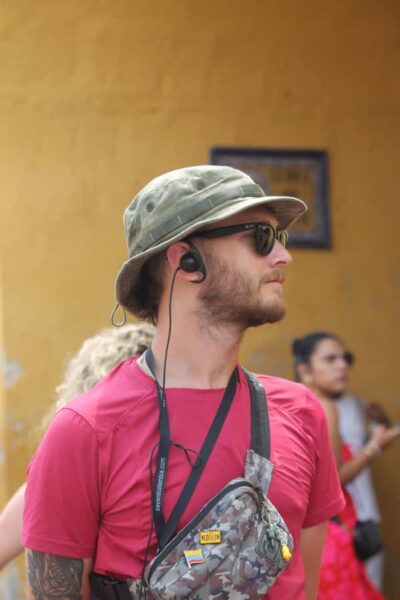
Shared Cartagena Old City Tour with Wireless Audio System
Read our review →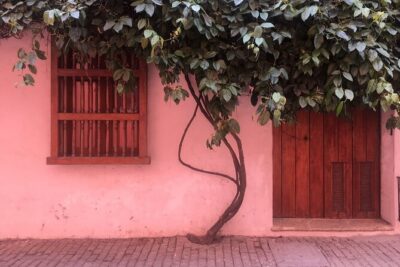
Walking Tour Cartagena Old City with Gold Museum and Plaza de Bolivar
Read our review →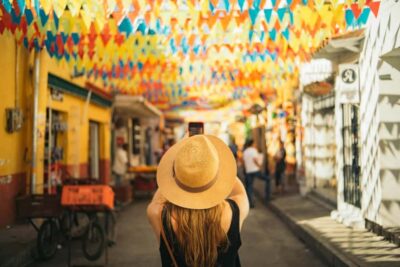
San Felipe Castle and Getsemani Walking Tour with tickets
Read our review →Browse the lists this tour appears in