
Reviewed · WALLED CITY & GETSEMANí TOURS
Shared Cartagena Old City Tour with Wireless Audio System
Cartagena’s best stories unfold on foot, and this tour puts you right inside the old walls, where pirates, merchants, priests, poets, and Afro-Caribbean communities shaped the city. The wireless audio system is especially useful on busy streets, letting you hear the guide while you stop for photos or walk at your own pace.
I like the $12 price, which buys you a solid orientation to the historic center without adding entrance fees or transport costs. I also like the guide-led storytelling, especially the odd little details, such as why the Clock Tower did not originally have a clock and how colonial buildings revealed social rank.
The main drawback is the distance. You may walk about 7 kilometers over two hours to two and a half hours, often in Cartagena’s heat, and the tour is not suitable for wheelchair users. One guide received praise for being clear and helpful, while another booking described the history as a set of disconnected facts, so the quality of the storytelling may depend on the person leading your group.
Key points at a glance
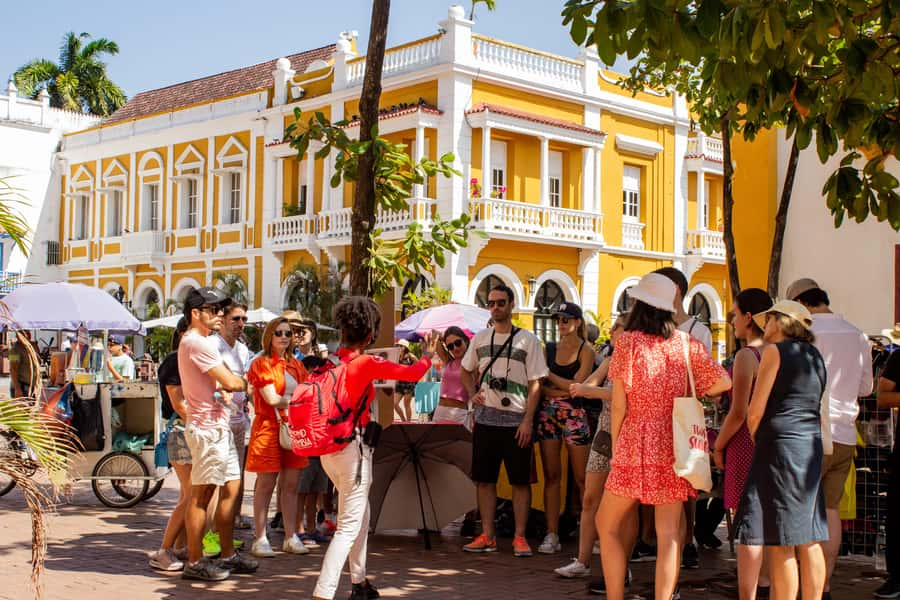
- Wireless audio in crowded streets: You can hear the guide clearly while taking photos or standing a few steps away.
- A proper look at the city walls: Bastions, cannon viewpoints, and defensive history explain why Cartagena was attacked more than ten times.
- The Clock Tower starts the story: This famous gateway leads into the old city and comes with an unusual detail about its original design.
- Colonial power in public squares: Plaza de la Aduana, Plaza de los Coches, Bolívar Square, and the Palace of the Inquisition show how trade, religion, and government shaped Cartagena.
- Useful local advice at the end: You receive a free tour map plus suggestions for food, coffee, souvenirs, and sunset spots.
- Weekend expansion: Saturday and Sunday departures may add Getsemaní, turning the walk into a larger tour of Cartagena’s historic center.
Starting beneath Cartagena’s Clock Tower
The tour begins at or near a meeting point assigned to the option you book. Since the meeting location can vary, check your confirmation carefully rather than assuming every departure starts in the same place.
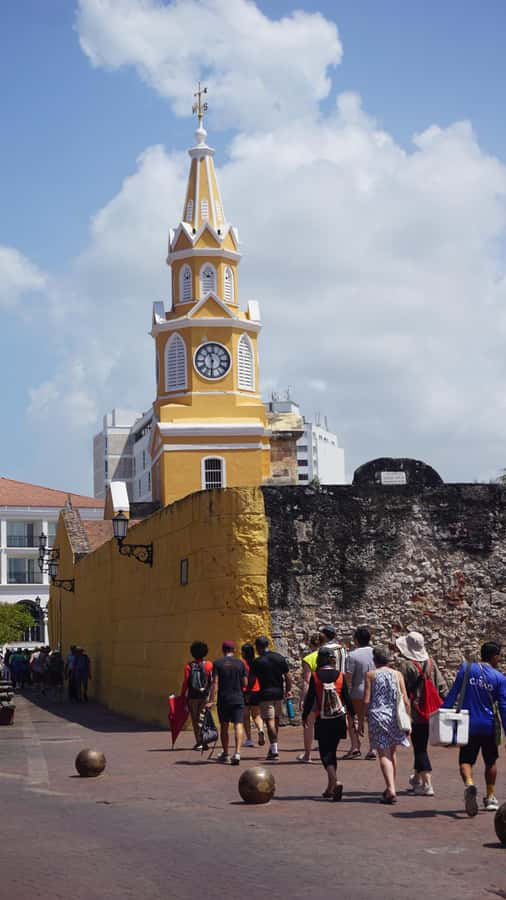
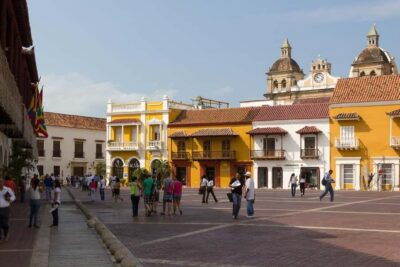
Most visitors associate the old city with the Clock Tower, or Torre del Reloj. This is the grand entrance into Cartagena’s Walled City, and it gives the walk an immediate sense of place. You are not beginning in a random street. You are entering through the city’s historic front door.
The guide uses the gateway to explain how Cartagena worked as a fortified port. The city was not protected by thick walls for decoration alone. Its position made it a prize for European powers, merchants, and pirates, and the fortifications were meant to guard trade and political power.
One of the tour’s more memorable details concerns the Clock Tower itself. It did not originally have a clock. That small fact is exactly the kind of detail that can make a familiar landmark more interesting, particularly if you have already seen photographs of the tower before arriving.
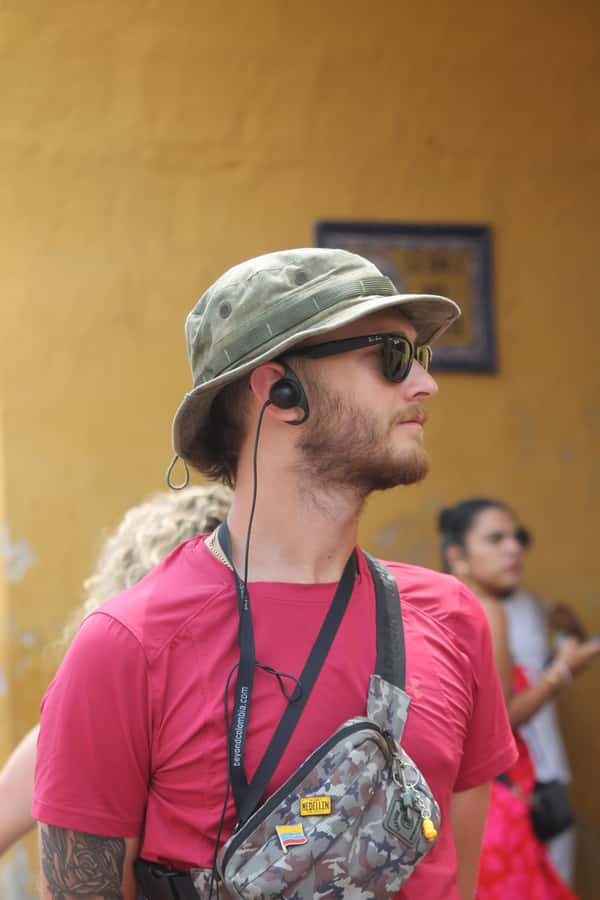
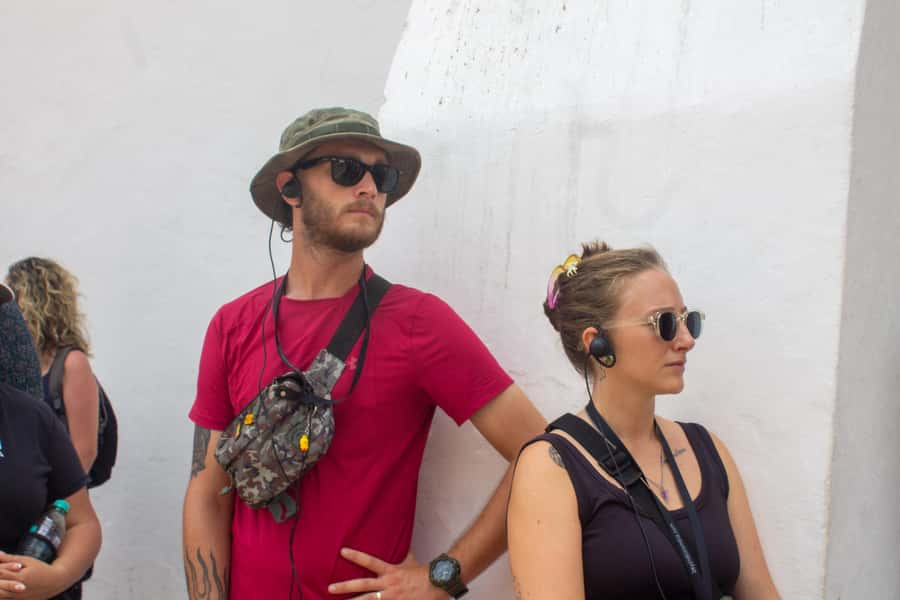
At the start, you receive a wireless audio receiver. This matters in Cartagena, where narrow streets, street vendors, traffic, music, and passing groups can make a guide hard to hear. You still need to stay aware of your surroundings, but you are less likely to miss a sentence while moving aside for a photo.
More City Tours in Cartagena
- Cartagena: City Sightseeing Hop-On Hop-Off Bus Tour & Extras
★ 3.9 · 681 reviews - Cartagena: Panoramic City Tour, Monuments, Walls, Castle
★ 4.0 · 636 reviews - Cartagena: BILINGUAL CITYTOUR + SAN FELIPE CASTLE & Old city
★ 4.2 · 387 reviews
Plaza de los Coches and the business of colonial Cartagena
From the entrance, the walk leads through Plaza de los Coches, one of the old city’s key public spaces. This was once a commercial center, so it helps explain Cartagena as a working port rather than simply a pretty colonial backdrop.
Look around as the guide describes the square. The arches, balconies, stonework, and open space reflect how commerce and movement were organized inside the walls. The city’s architecture was shaped by trade, defense, religion, and social rank all at once.
The tour pays attention to the way buildings revealed status. A balcony, doorway, or larger residence could signal wealth and social position. In a compact city, architecture also carried gossip. You may find these details more useful than a long list of dates because they help you read the streets after the tour ends.
The pace includes resting stops, but this is still an active walking experience. You will likely pause to listen, then continue through the streets rather than remain in one place for a long lecture. The wireless system supports that format well, since you can keep listening while looking up at facades or taking pictures.
Plaza de la Aduana and Cartagena’s trading power
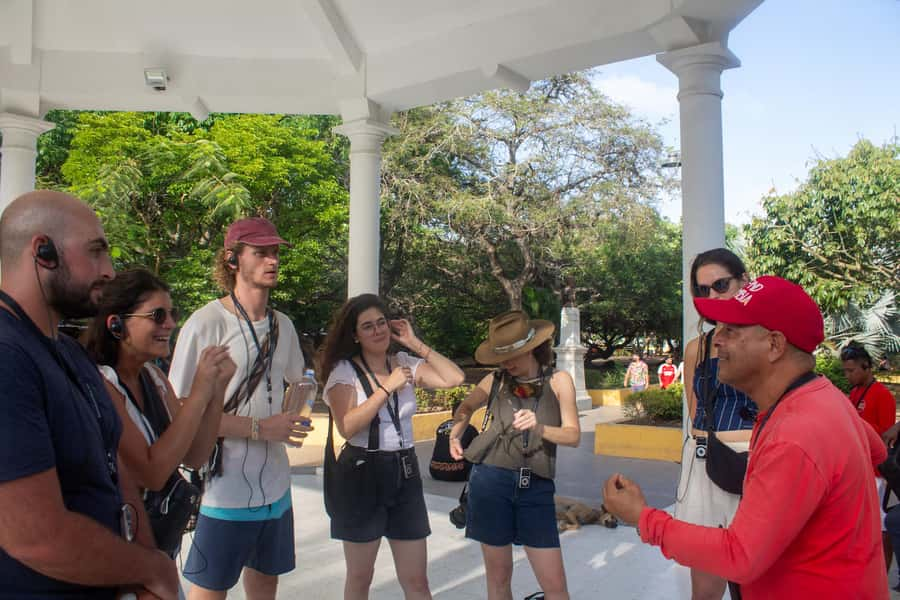
Plaza de la Aduana was the colonial trade center, and it gives the tour a clear economic thread. Cartagena grew through movement: goods arrived, taxes were collected, officials made decisions, and ships connected the city to a much larger empire.
The guide links the square to the city’s defensive role. A port full of valuable cargo needed protection, and that helps explain why Cartagena became one of the most fortified cities in Latin America.
This is also where the tour’s broader stories about attacks make sense. Cartagena was assaulted more than ten times by French, Dutch, English, and Spanish forces. That history is not just a dramatic aside. It explains the walls, bastions, cannon positions, guarded entrances, and the careful design of the old city.
If you prefer a tour that spends all its time inside buildings, this walk will not be the right match. The focus is on streets, squares, exteriors, public history, and city design. Tickets and entrance fees are not part of the plan, and the guide does not take you somewhere that suddenly demands an extra charge.
Bolívar Square and the city’s political heart
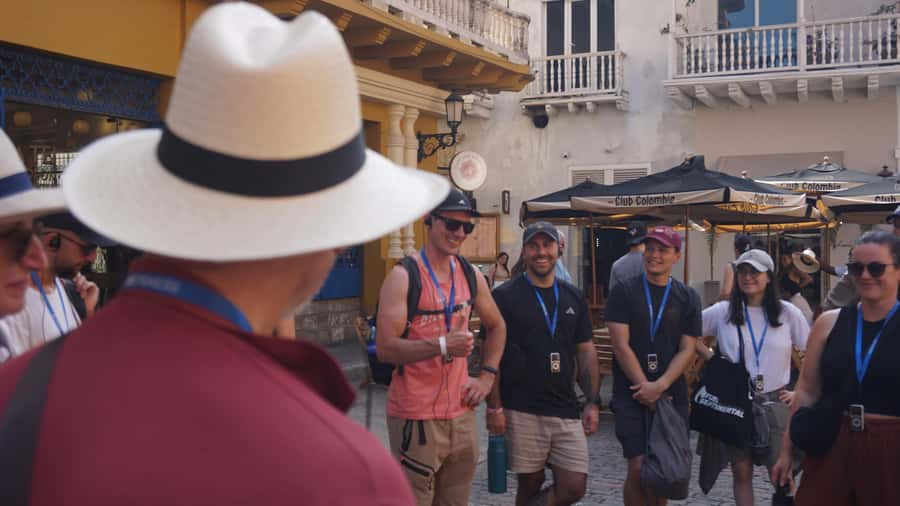
Bolívar Square brings you into the political and civic center of old Cartagena. Public squares here connect government, religion, commerce, and daily life. The tour uses this part of the route to explain how Cartagena developed beyond its military walls.
You may find the square a welcome pause after the busier entrance streets. It is a good place to look at the relationship between open public space and the buildings around it. The guide’s job is not only to identify each structure, but to explain what happened in these places and why their location mattered.
This is also a useful point for questions. One strong feature of the experience is the live guide rather than a fixed audio recording. A guide can respond when you ask about local food, neighborhoods, architecture, or places to return later.
A guide named Juli received especially warm praise for making the tour enjoyable. Another guide was described as clear, highly educated, and very familiar with Cartagena’s past. At the same time, one booking found the information less connected, with historical facts that did not form a smooth story. I would therefore approach the tour as a helpful overview, while recognizing that the guide’s style can shape how well the pieces fit together.
More Shared Tours in Cartagena
- Cartagena: Historic Center and Getsemaní Shared Walking Tour
★ 4.9 · 2,716 reviews - Cartagena: Walled City and Getsemani Shared Walking Tour
★ 4.5 · 352 reviews - Gabriel Garcia Marquez Shared Tour: the magical Cartagena
★ 5.0 · 82 reviews - Shared Old Cartagena & Getsemani Tour with Wireless System
★ 4.4 · 8 reviews
The Cathedral and the role of faith
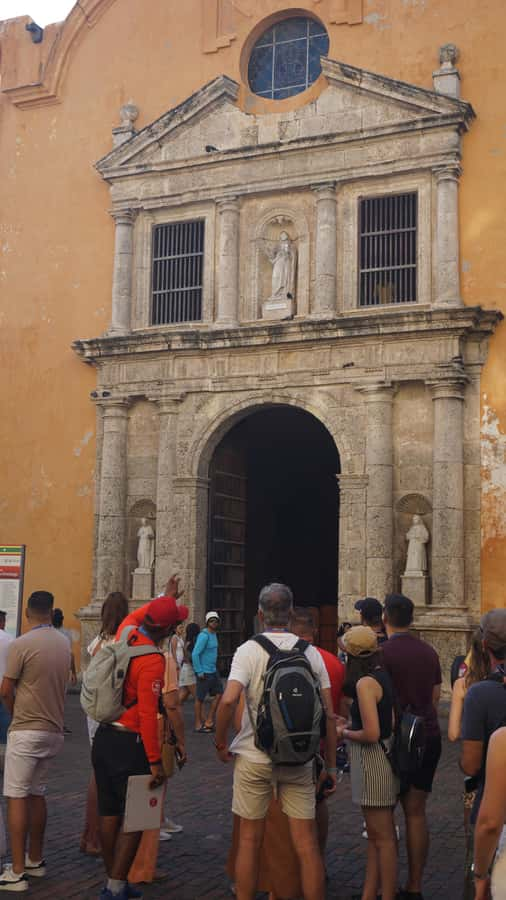
Cartagena Cathedral is one of the essential stops. Its colonial architecture reflects the central place of faith in the city’s public life, and the building helps balance the tour’s focus on trade and military defense.
You will hear about the cathedral as an active symbol of Cartagena’s religious identity, not just as a photo stop. Look at the scale and placement of the structure in relation to the surrounding streets. Churches were powerful public markers in colonial cities, and their presence often tells you as much about authority as a government building does.
The tour may not include entry to the cathedral or any other paid attraction. That keeps the price simple, but it also means you should not expect a museum-style interior visit as the main part of the walk. If you want to explore the inside of a particular building, ask the guide for current advice and return on your own.
The Palace of the Inquisition and the San Pedro Claver area
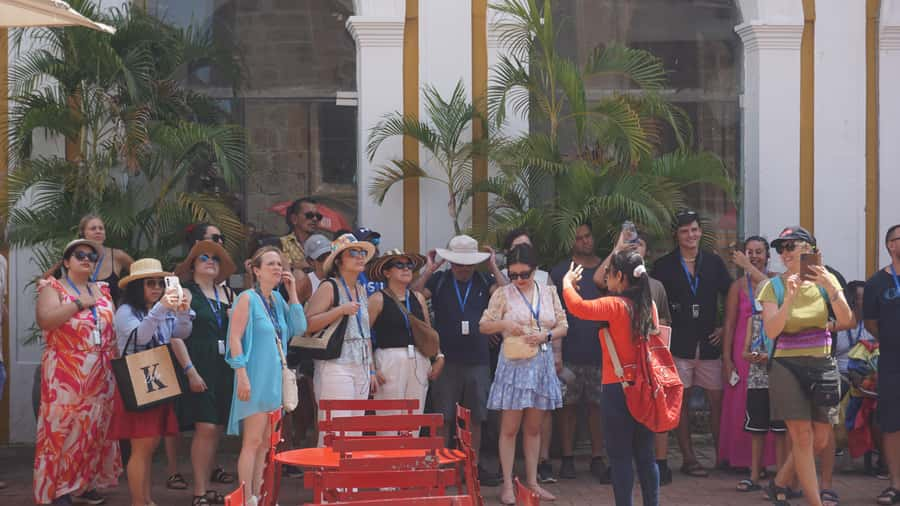
The Palace of the Inquisition adds a darker side to Cartagena’s story. Its name connects the old city to religious authority, colonial justice, and the systems used to control belief and behavior.
The tour places this site among other major landmarks instead of treating Cartagena as a string of pretty squares. That broader approach is useful. The old city’s polished facades can hide difficult stories, and a good guide should help you see both the beauty and the power structures behind it.
The San Pedro Claver area brings another important layer. Here the tour considers religion, social change, and the people who shaped Cartagena’s identity. The experience also gives attention to Afro-Caribbean heritage, which is essential if you want more than a European colonial version of the city.
I appreciate that the walk connects the past with present-day life. The guide can point you toward food, music, and places for sunset, showing how Cartagena’s traditions continue rather than treating the old city as a frozen monument.
Walking the walls and looking toward the harbor
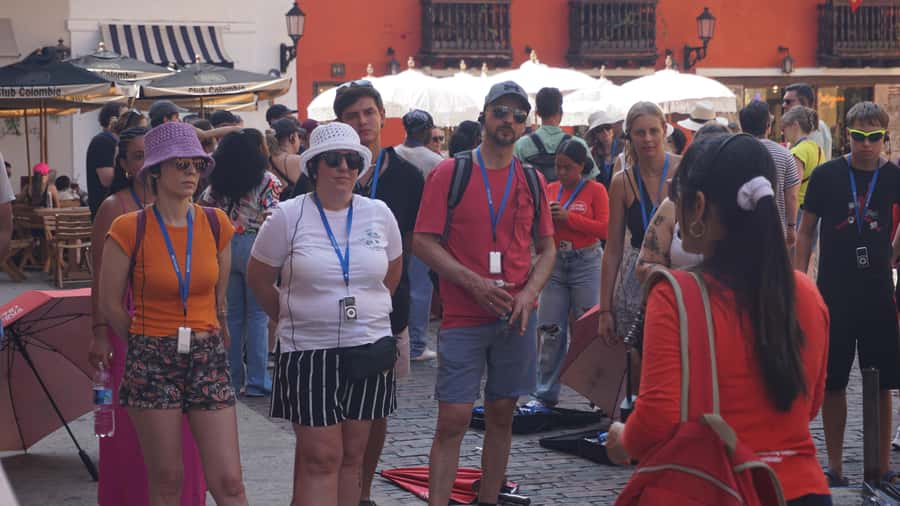
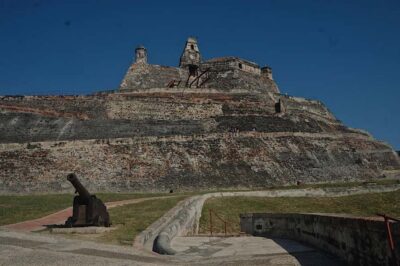
The city walls are one of the strongest parts of the route. You will see fortifications, bastions, and cannon viewpoints that make the military story physical. Instead of hearing only that Cartagena was heavily defended, you can understand how the walls shaped movement and sightlines.
The walls also provide some of the tour’s best photo corners. Bring a phone or camera, but keep listening through the wireless receiver. The system is useful here because you can pause for a view without completely losing the guide’s explanation.
Expect a walking route rather than a slow sightseeing bus. The tour covers roughly 7 kilometers, includes resting stops, and lasts between two hours and 150 minutes depending on the departure and pace. Wear shoes that can handle uneven streets and bring water. Cartagena’s heat can make a short walk feel much longer.
A rainproof coat or umbrella is wise. The tour operates outdoors, and the weather can change. Comfortable clothing is more important than dressing up, especially if you plan to continue exploring afterward.
What the wireless system changes
Audio equipment may sound like a minor extra, but it affects the entire walk. In a shared group, people naturally spread out. Some want photographs, others stop to look at a doorway, and others prefer to walk near the guide.
The receiver lets you remain part of the conversation without standing shoulder to shoulder with everyone else. It can also help in noisy streets. This does not turn the walk into a private tour, but it makes a shared tour feel less cramped.
The system is offered for English and Spanish experiences, and the live guide speaks one of those languages according to the option selected. The activity also lists an optional audio guide in English or Spanish, so check the booking choice carefully if you want a particular format.
Saturday and Sunday in Getsemaní
For Saturday and Sunday departures, the tour is scheduled to add the Getsemaní district from February 1 onward. The operator calls this the Great Historic Center of Cartagena, combining the Walled City with a neighborhood known for its cultural and local character.
This change could make the weekend version particularly useful if you want a broader first look at Cartagena. You can see both the formal colonial center and another historic district in one outing, rather than booking separate introductory walks.
The announced weekend times are 10 a.m. and 4 p.m. The later departure may suit you if you prefer softer light and want to continue toward an evening meal, though the length of the route means you should still plan your energy and water carefully.
Because the meeting point and route can vary by option, confirm that Getsemaní is included in the departure you select. Do not assume every weekday or weekend booking follows the same route.
Is $12 a good value?
At $12 per person, this is an easy tour to justify if you are new to Cartagena. You get a live English or Spanish-speaking guide, wireless audio, a structured route through the main old-city landmarks, and local suggestions for places to eat, buy coffee, purchase souvenirs, or watch the sunset.
There is no transportation to the meeting point, hotel pickup, food, drinks, or souvenir included. That is normal for a walking tour, and it keeps the price low. You should budget for your own water and any meal or coffee afterward.
The tour is shared, not private. You will meet other people, and the guide will not design the route around your personal interests. If you want a slow architectural study or a private conversation about colonial politics, a private guide would give you more control.
For a first afternoon in Cartagena, I think the value is strong. The tour gives you the street map and historical framework you need before exploring alone. The free tour map and partner discounts may also help you plan the rest of your stay, though their usefulness depends on which recommendations match your taste.
Who should book this walk?
I would choose this tour if you want a broad introduction to Cartagena, prefer learning through stories, and do not mind walking several kilometers. It suits first-time visitors who want to understand why the city has walls, towers, plazas, churches, and grand colonial buildings before returning to explore them at leisure.
It is also a good fit if you want practical advice about food, coffee, music, souvenirs, and sunset spots from someone leading you through the city. The wireless audio is helpful for people who dislike losing the guide’s voice every time they stop for a photograph.
You may want another option if you use a wheelchair, dislike outdoor walking in heat or rain, or want entry inside several monuments. The tour does not include transportation or paid entrances, and its shared format means the pace may not suit everyone.
Keep your belongings close in crowded areas. The local warning not to give papaya is a colorful way of saying do not make it easy for someone to take advantage of carelessness. Carry water, protect yourself from rain, and tell the operator if you can no longer attend so the guide is not waiting unnecessarily.
Should you book the Shared Cartagena Old City Tour?
Book it if you want an affordable first orientation with the city’s essential landmarks, a live guide, and clear audio in the middle of busy streets. The strongest reasons are the low price, the practical local recommendations, and the route’s mix of trade, religion, politics, defense, and Afro-Caribbean identity.
I would be slightly cautious if you need a perfectly connected historical narrative. One account found the facts less fluid, while other feedback praised guides for clear explanations, good answers, and useful recommendations. If you book, ask questions and use the walk as your framework for exploring more on your own.
For most able-bodied visitors who have only a short time in Cartagena, $12 is a sensible investment. Choose the 10 a.m. or 4 p.m. weekend departure if you want the announced Getsemaní addition, and confirm the meeting point before setting out.
FAQ
How long does the Cartagena Old City Tour last?
The tour lasts approximately two hours to 150 minutes. The route covers about 7 kilometers and includes stops to rest and listen to the guide.
What language is the tour offered in?
The live tour guide is available in English or Spanish. An optional audio guide is also listed in English and Spanish.
Does the tour include transportation?
No. You are responsible for reaching the meeting point, and the tour itself is done on foot. Hotel transportation is not included.
Are food, drinks, or entrance tickets included?
No. Food, drinks, souvenirs, and paid entrances are not included. The route focuses on outdoor sightseeing and does not take you to places with unexpected extra charges.
Is the tour wheelchair accessible?
No. The activity is not suitable for wheelchair users, and the walking route covers about 7 kilometers.
Can I cancel the tour or pay later?
You can cancel up to 24 hours in advance for a full refund. Reserve now and pay later is also available, depending on the booking option.
More Walled City and Getsemani Walks
- Cartagena: Walled City & Getsemani Private Tour
★ 4.8 · 107 reviews - Walled City, Getsemani San Felipe Castle Cartagena City Tour
★ 4.7 · 91 reviews - Walking Tour Cartagena Old City with Gold Museum and Plaza de Bolivar
★ 4.5 · 28 reviews - San Felipe Castle and Getsemani Walking Tour with tickets
★ 4.3 · 27 reviews
Just added around Cartagena
- White Night Boat Party: Dinner Buffet, Dancing and Open Bar★ 4.6 · 3 reviews
- Exotic Yacht – Tour through the bay of Cartagena★ 3.7 · 4 reviews
- Volcan del Totumo + Playa + Piscina★ 4.7 · 4 reviews
- cartagena: Mucura and Santa Cruz Islands Tour spectacular★ 4.0 · 12 reviews
- Enjoy the totumo volcano from cartagena + snack★ 4.0 · 11 reviews
- 5 islands tour to rosario Islands with snorkeling activity!★ 4.5 · 36 reviews
- Romantic Date Night in the Bay of Cartagena★ 5.0 · 47 reviews
- Totumo volcano tour + snack★ 4.5 · 44 reviews
Walled City & Getsemaní Tours, compared.
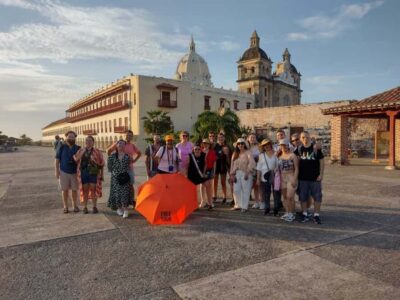
Historic Center and Getsemaní Shared Walking Tour
Read our review →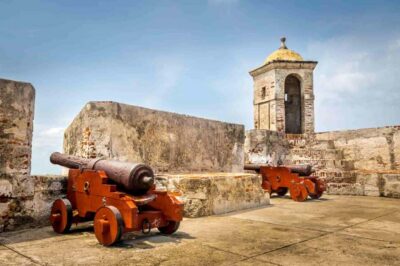
BILINGUAL CITYTOUR + SAN FELIPE CASTLE & Old city
Read our review →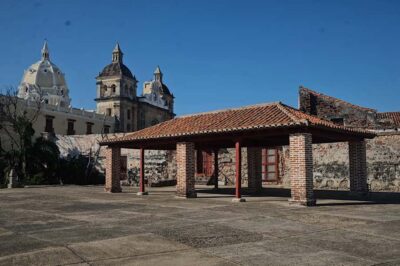
Walled City, Getsemani San Felipe Castle Cartagena City Tour
Read our review →
Walking Tour Cartagena Old City with Gold Museum and Plaza de Bolivar
Read our review →
San Felipe Castle and Getsemani Walking Tour with tickets
Read our review →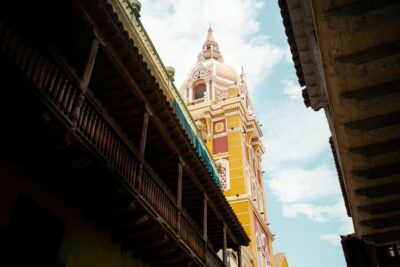
Browse the lists this tour appears in