
Reviewed · HISTORICAL TOURS
Historical tour Bogota
Bogotá’s past comes at you in layers on this three-hour walking tour through La Candelaria, La Concordia, and Las Aguas. You move from Spanish colonial buildings to the story of El Dorado, then on to independence, the Bogotazo, Colombian violence, Botero, García Márquez, chicha, emeralds, and practical tips for the rest of your stay. I like the wide range: this is not only a parade of old buildings. It connects art, politics, food, and ordinary life.
I also like the guides’ personal approach. Paula is praised for linking history and literature, while Ricardo, Jennifer, Diane, Carlos, and Rodrigo are all named in positive comments for clear explanations, friendly manners, punctuality, and useful city advice. The main drawback is simple: you walk outdoors for nearly three hours, and the tour runs in bad weather, so bring an umbrella and wear shoes you can trust.
Key points to know before you book
- Three historic districts in one walk: The route covers La Candelaria, La Concordia, and Las Aguas rather than staying around one square.
- Big Colombian subjects made local: El Dorado, independence, the Bogotazo, violence, Botero, and García Márquez all appear along the way.
- A useful food stop: La Concordia Market gives you a chance to try chicha, order a Colombian juice, or browse for a small souvenir.
- Guides with different strengths: Paula, Ricardo, Jennifer, Diane, Carlos, and Rodrigo have all led well-received versions of the tour.
- Good orientation for a first visit: The final stop includes suggestions for restaurants and other things to do in Bogotá.
- Outdoor and weather-dependent: The route is free-entry at each stop, but the walking, altitude, uneven city streets, and rain require moderate fitness.
Why this is a smart first look at Bogotá
I like this tour because it gives you a working map of Bogotá’s old center, not just a list of monuments. You begin near Carrera 7 in La Candelaria and finish at Rosario Square, passing through several areas that feel different in character and purpose.
The route also explains why Bogotá matters beyond its capital-city label. You hear about the Indigenous people connected with the area, the legend of El Dorado, Spanish colonization, Colombia’s independence, and the political shocks that shaped modern Bogotá. That range helps you understand later visits to museums, churches, markets, and viewpoints.
At $19.77 per person, the advertised price is modest for about three hours with a guide. Since the scheduled stops have no admission charge, most of what you are paying for is the interpretation, route planning, and local orientation. Group discounts may improve the value for families or larger parties.
The word free in the tour title deserves a quick note. The experience has a listed price, and some people choose to offer an additional tip based on the tour they receive. The supplied information confirms the price but does not set out a required gratuity, so check the booking terms before you go.
More historical tours in Bogota:
- Shared Tour of Bogota’s Historic Downtown (La Candelaria)
★ 4.7 · 100 reviews - 7-hour City Tour of Historic Bogotá with Monserrate
★ 4.7 · 47 reviews - From bogota: Salt Cathedral tour a Cultural Heritage Tour
★ 4.5 · 23 reviews
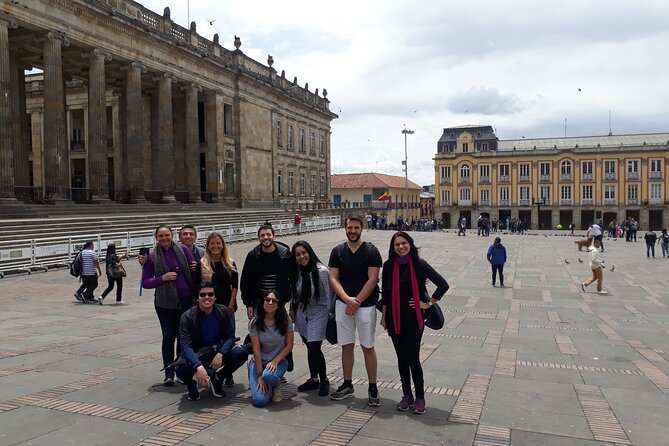
Plaza de Bolívar, where the city story begins
The first stop is Plaza de Bolívar, the natural place to frame Bogotá’s political and historical story. You spend about 30 minutes here, learning how the city began and looking at important national buildings.
This is one of the strongest openings because the square gives the guide room to explain several periods at once. You can expect discussion of Indigenous life, Spanish rule, the creation of the capital, and Colombia’s political development. The buildings help turn those subjects into something visible rather than abstract.
The stop is also useful for first-time visitors who want to know how the center is organized. Listen for references to nearby streets and buildings, since they can help you return later on your own.
Teatro Colón and the Bolívar connection
The route then moves to Teatro Colón for about 15 minutes. The theater is presented as one of Colombia’s notable architectural sights, and the stop also connects to Simón Bolívar, who lived in the area.
This is a short visit, so expect exterior commentary rather than a long theater program or an extended indoor tour. The value is in seeing how Bogotá’s cultural life and independence-era politics meet within a compact part of the city.
I would treat this as a context stop. If you are especially interested in theater interiors or Bolívar’s life, you may want to ask the guide for more detail and note the location for a later visit.
The Banco de la República cultural block and Botero
At the museums of the Banco de la República, the guide explains the cultural block around La Candelaria from outside. You also hear about Fernando Botero, one of Colombia’s best-known artists.
This part should appeal to art lovers, but it is also useful if you plan to visit museums during your stay. The guide can help you understand why this cluster matters before you decide how much time to spend inside individual museums.
The stop lasts about 15 minutes. Since the tour does not include museum admission or an extended museum visit, keep your expectations clear. You are getting an introduction and a location guide, not a full art tour.
A few more Bogota half-days worth weighing up
- Bogota: Bicycle City Tour
★ 4.9 · 2,156 reviews - Zipaquirá: Salt Cathedral Group Tour with Pickup
★ 4.8 · 1,606 reviews - Bogotá: Guided La Candelaria Walking Tour
★ 4.8 · 1,229 reviews - Bogotá: Private City Tour, Monserrate, Emerald and Botero
★ 4.9 · 798 reviews
Chorro de Quevedo and the story of chicha
Plaza del Chorro de Quevedo is described as Bogotá’s foundation square. Here, the tour shifts from formal national history to the smaller stories that give La Candelaria its character.
You learn about the square’s importance and why chicha, a traditional fermented drink, was prohibited. That detail offers a useful window into the clash between Indigenous customs, colonial authority, public policy, and modern ideas about Colombian identity.
The stop lasts around 20 minutes. It is a good place to ask questions, particularly if you want to understand why certain foods and drinks carry political or cultural meaning. The walk continues through old streets, so keep your attention on the guide and your footing.
La Concordia Market for chicha, juice, and souvenirs
At Plaza de Mercado La Concordia, the tour moves indoors to a market setting. You can buy a traditional chicha, choose a typical Colombian juice, or purchase a souvenir, but food, drinks, and shopping are not included in the tour price.
I like this stop because it gives the history a practical finish. Instead of hearing about Colombian culture only at monuments, you get a chance to make a small choice for yourself. Try the local drink if you are curious, or simply look around and save your money for a later meal.
Budget a little extra if you want to purchase something here. The supplied information does not give prices or specify how long you can stay shopping, so do not treat the market as a planned meal stop.
The Eje Ambiental and a view toward Monserrate
The Eje Ambiental provides a change of pace and a view toward Monserrate. The guide points out how to reach the hill, which is one of Bogotá’s best-known sights, and identifies a square associated with Gabriel García Márquez’s social life.
This stop is especially useful because it links the old center with a major activity you may want to do later. If Monserrate is on your list, pay attention to the directions and ask about the best way to plan that visit.
The García Márquez connection adds a literary thread to a tour that already includes politics, art, and food. The stop lasts around 15 minutes, enough for an introduction and photographs, though not a full literary study.
Jorge Eliécer Gaitán and the Bogotazo
At the monument to Jorge Eliécer Gaitán, the tour takes on some of Colombia’s hardest history. You learn who Gaitán was, why he mattered, and how his death relates to the Bogotazo and the violence that followed in Colombia.
This may be the most important historical stop for understanding modern Bogotá. The Bogotazo was not just one event in a textbook. It reshaped the capital, and the guide uses this part of the route to connect political conflict with the city around you.
Expect serious subject matter, handled within a general city walk rather than a specialist political seminar. The visit lasts about 20 minutes. If Colombian politics interests you, this is a good moment to ask for suggested museums, books, or places to explore later.
Rosario Square and the emerald trade
The tour ends at Plazoleta del Rosario, known here for its emerald market. The guide explains what emeralds mean in Colombia and how the stones are traded in a somewhat informal setting.
This is a memorable final stop because it deals with a living part of the city’s economy rather than only its past. You may see how emeralds are presented and marketed, but there is no guarantee that you will make a purchase or see a particular transaction.
The guide also gives recommendations for restaurants and other places to visit. That makes the ending practical. You finish near Av. Jiménez de Quesada, with ideas for your next meal and the rest of your Bogotá stay.
What the guide style is like
The experience uses different guides, so the tone may vary by departure. Paula receives especially strong praise for her explanations of Colombian history and politics, as well as for connecting the route with literature. Ricardo is described as attentive and clear, while Jennifer is noted for using pictures to explain historical details.
Diane is praised for covering all of La Candelaria in a well-organized way. Carlos is described as giving a strong introduction to the district and its surroundings, and Rodrigo is noted for keeping a nearly three-hour route moving at a good pace.
The common thread is a friendly, interactive style. One version included questions about the material already discussed, which can help you stay involved instead of simply listening. Spanish-language departures are available based on the supplied comments, though the available information does not state all language options or schedules.
The group can reach 30 people. That is large enough to create energy but also large enough for the guide to be harder to hear in noisy streets. Stay near the guide, especially at crossings and busy squares.
Practical details that affect the day
The meeting point is Cra. 7 #11-10 in La Candelaria. The tour ends at Rosario Square, Av. Jiménez de Quesada #6-71, also in La Candelaria. It is near public transportation, but the exact transit route is not provided, so use the map link and allow time to locate the starting point.
You need moderate physical fitness. The route lasts about three hours and includes continuous outdoor walking through central Bogotá. Comfortable shoes are more important than stylish ones, and an umbrella is essential because the tour operates in bad weather.
Service animals are allowed. The tour does not include snacks, drinks, meals, museum tickets, or purchases. Bring some Colombian pesos if you want chicha, juice, a souvenir, or a meal after the walk.
Confirmation is provided at booking. Cancellation is free up to 24 hours before the start time, with a full refund. Changes or cancellations made less than 24 hours before the start are not accepted for a refund.
Who will get the most from this walk
I would choose this tour if you are new to Bogotá and want a broad introduction before deciding how to spend the rest of your visit. It suits people who like history explained through streets, monuments, food, art, and politics rather than through one museum collection.
It is also a good fit if you have limited time. The route gives you a fast look at La Candelaria and helps you decide which places deserve a longer return visit. The guides’ restaurant, coffee, money-changing, and museum suggestions can save time later, although the exact recommendations depend on who leads your group.
You may want something else if you prefer small private tours, long indoor museum visits, or a slow photography walk. A group of up to 30 people and a three-hour outdoor route can feel busy, especially in rain or on crowded streets.
Should you book the Bogotá historical tour?
Book it if you want a reasonably priced first orientation to Bogotá with serious history, local culture, and useful advice folded into one walk. The strongest features are the range of subjects, the market stop, the Gaitán and Bogotazo discussion, and the chance to hear from guides such as Paula, Ricardo, Jennifer, Diane, Carlos, or Rodrigo.
Skip it if your priority is an in-depth visit to museums or a private guide who can set the pace around your interests. For most first-time visitors who can manage three hours on foot, this is a practical way to begin in Bogotá. Bring rain protection, stay close to the guide, and save a little cash for chicha, juice, or a snack at La Concordia.
FAQ
How long does the historical Bogotá tour last?
The tour lasts approximately three hours.
Where does the tour start?
It starts at Cra. 7 #11-10 in La Candelaria, Bogotá.
Where does the tour end?
The tour ends at Rosario Square, at Av. Jiménez de Quesada #6-71 in La Candelaria.
What places does the walking tour visit?
The route includes Plaza de Bolívar, Teatro Colón, the Banco de la República museum area, Plaza del Chorro de Quevedo, La Concordia Market, the Eje Ambiental, the Jorge Eliécer Gaitán Monument, and Rosario Square.
Are entrance tickets included?
The listed stops have free admission, and the experience includes a guide and a walking tour of central areas. Museum admission, food, drinks, and purchases are not included.
Can I try chicha during the tour?
Yes. At La Concordia Market, you can buy traditional chicha, a Colombian juice, or a souvenir. These purchases cost extra.
Does the tour operate in bad weather?
Yes. The tour is not cancelled because of bad weather, so you should bring an umbrella.
How many people can join the tour?
The maximum group size is 30 people.
Just added around Bogota
- Zipaquirá: Private tour to the Salt Cathedral, Colombia’s first wonder★ 4.9 · 33 reviews
- Zipaquira: 5 hrs Salt Cathedral Tour★ 4.4 · 9 reviews
- Wonders of Salt: Colombia’s Underground Cathedral★ 5.0 · 18 reviews
- Zipaquirá Salt Cathedral & Andrés Carne de Res (Chía)★ 4.6 · 30 reviews
- Zipaquirá: Private Salt Cathedral Mine and Walking Tour★ 4.8 · 3 reviews
- Villa de Leyva Trip by Private Transportation★ 4.8 · 27 reviews
- Wonderful tour of Villa de Leyva, and Zipaquira Salt Cathedral.★ 4.5 · 34 reviews
- Private Zipaquira Salt Cathedral and Guatavita Lagoon Tour from Bogota★ 4.5 · 44 reviews
Historical Tours, compared.
Historic Center and Getsemaní Shared Walking Tour
Read our review →

History & Local Life Essentials Tour on an E-Bike
Read our review →
Historical Shared Tour Salsa, Graffiti & Resistance in Cali
Read our review →
Shared Tour of Bogota’s Historic Downtown (La Candelaria)
Read our review →

Browse the lists this tour appears in