
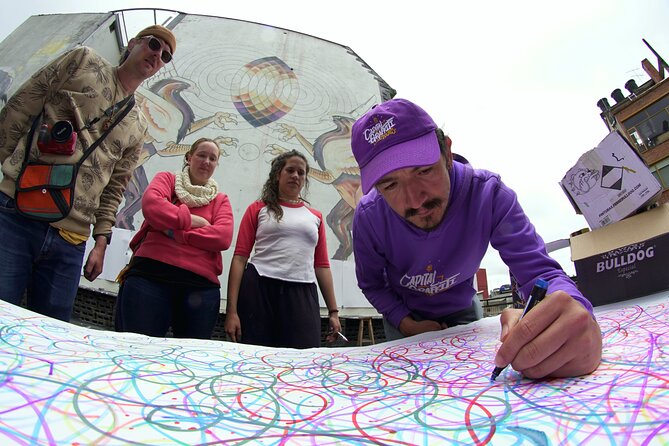
Reviewed · STREET ART
Fun Graffiti Workshop: The Art of Aerosol and Color
Bogotá’s graffiti scene can look effortless from the street. This workshop shows you the less effortless part: how to control a can, build a tag, choose colors, and make a name pop in throwup 3D style. You begin at OCIO Gallery, then move into a courtyard where the wall becomes your practice sheet.
I like the clear progression from simple dots, lines, and spirals to a finished piece. I also like the chance to work with artists such as Cali, known professionally as TET, or Diego, rather than simply walking past finished murals with a camera. The main caution is practical: spray cans may be partly empty, and a lively family group can make a small workshop feel less focused.
Key things to know before you book
- You make your own graffiti name: The central project is a personal tag, planned on paper and painted in a 3D throwup style.
- The workshop starts at OCIO Gallery: You can see Colombian prints and printed clothing before heading to the courtyard.
- You learn by doing: The session covers can handling, nozzle use, warm-up exercises, color choices, and wall technique.
- The group is small: A maximum of 10 people keeps the activity more manageable than a large art class.
- Everything needed for painting is supplied: Spray cans, markers, nozzles, thick paper, and wall space are included.
- Bring realistic expectations: The quality of the session can depend on can supplies and how well the group stays engaged.
Starting at OCIO Gallery in Bogotá
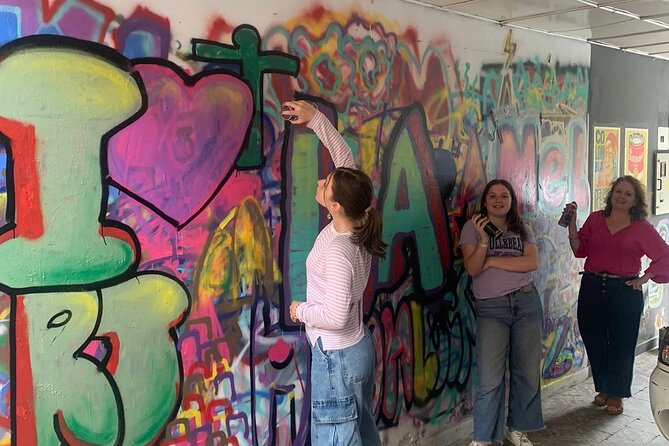
The meeting point is Ocio Gallery at Cra. 5 #26b-26 in Bogotá. This is more than a place to wait for the instructor. The gallery displays prints by Colombian artists and sells printed clothing, giving you a quick look at the creative setting before the paint starts flying.
I like this opening because it gives the workshop some context. You are not being dropped beside a blank wall with a can in your hand. You first see finished artwork and can browse possible souvenirs. The gallery is also near La Perseverancia Market and several places to eat, so you can pair the class with a meal before or after.
The workshop itself takes place in a courtyard behind the gallery. Its walls carry experiments and tags from past participants, which makes the setting feel active and informal. It is also a useful visual lesson: you can see how different people have approached the same basic materials.
The session lasts about two hours. That is long enough to learn the fundamentals and finish a small project, but not so long that the novelty wears off. I would treat this as a focused art class, not a full-day introduction to Bogotá’s street-art scene.
More Street Art Tours in Bogota
- Bogotá: La Candelaria Graffiti & Urban Art Guided Tour
★ 4.7 · 250 reviews - Graffiti Tour in La Candelaria Bogotá with Transportation
★ 5.0 · 68 reviews - Bogotá: Graffiti Tour el mejor recorrido de arte urbano
★ 4.7 · 41 reviews
A practical introduction to spray paint
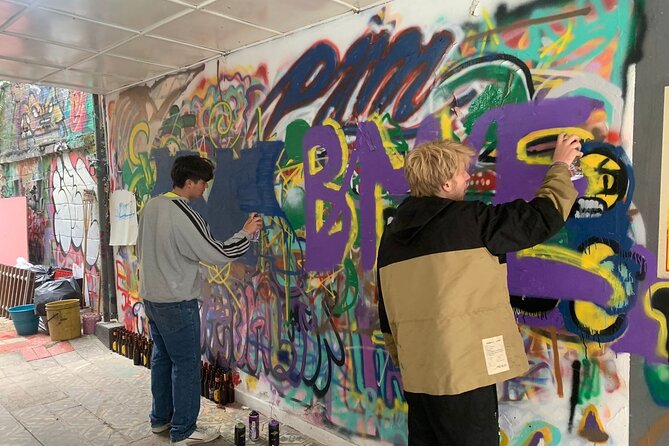
The instructor begins by explaining the goal: invent a graffiti name and paint it as a throwup with a 3D effect. Materials and quantities are laid out, and you are asked for permission before photographs are taken. That consent step is a small but welcome detail, especially if you are booking for children or prefer not to appear in promotional pictures.
You are encouraged to stretch your hands and body before picking up a can. It may sound playful, but the warm-up has a purpose. Spray painting uses your wrist, fingers, shoulders, and whole arm in ways that feel unfamiliar if you usually work with a pencil or brush.
Then comes the memorable demonstration. The instructor shakes a can and mimics a giant signature in the air, showing how broad arm movements can shape letters. This helps you see that graffiti is not simply writing a name in large letters. It is a physical process involving speed, distance, pressure, and movement.
The early exercises are simple:
- Dots
- Straight lines
- Spirals
- Basic tag forms
These drills let you feel how the paint comes out and how the nozzle changes the mark. You gradually move from control exercises to a personal design. For a complete beginner, this is the right order. You gain a little control before trying to create something recognizable.
Planning a tag before touching the wall
Once you have tried the can, you begin inventing your graffiti name. You can use a nickname, initials, or a new word. The important point is that the tag belongs to you, rather than being a preset design handed out to the group.
The instructor helps you work through the idea on thick paper first. This planning stage matters. A wall gives you less room for correction than paper, and it is easier to adjust letter shapes, spacing, and color combinations before you start spraying.
You also use graphic markers during the design process. They help you test the overall shape and get a feel for how the letters may sit together. The instructor can offer suggestions and help shape the final design so it has stronger impact.
I especially like this part for families and mixed-age groups. A child can focus on large shapes and color, while an adult can think more carefully about lettering and depth. The project has enough structure to prevent confusion, yet enough freedom to let each person create something different.
The phrase throwup can sound intimidating if you know nothing about graffiti. Here, it refers to a bold, quick style built around large letters, outlines, and simple depth. You are not expected to produce a museum piece. The aim is to understand how a tag is built and leave with a design that feels personal.
Moving from paper to the courtyard wall
After planning, you choose colors and take your design to the wall. The activity supplies spray cans, nozzles, and wall space, so you do not need to arrive with specialist equipment.
The instructor coaches you as you work. Expect help with the basic mechanics of holding the can, keeping a steady distance, and making the lines look cleaner. You may also get advice on how to strengthen the outline or make the 3D effect more visible.
This is where the workshop becomes more than a craft activity. You are making decisions in real time. The wall has texture, the paint behaves differently than a marker, and your first lines may not look exactly as planned. That is part of the lesson.
A strong instructor can make a big difference here. Cali, who works under the name TET and has pieces around Bogotá, is described as giving frequent pointers and helping participants shape their finished tags. Diego is also identified as an engaging guide who worked well with children. Since the instructor may vary, your exact teaching style can depend on the date you book.
The courtyard wall also removes some pressure. You are not trying to alter a public building or compete with a large professional mural. You have a designated space where mistakes and experiments belong.
A completely different kind of day, same corner of Colombia:
- Bogota: Bicycle City Tour
★ 4.9 · 2,156 reviews - Zipaquirá: Salt Cathedral Group Tour with Pickup
★ 4.8 · 1,606 reviews - Bogotá: Guided La Candelaria Walking Tour
★ 4.8 · 1,229 reviews - Bogotá: Private City Tour, Monserrate, Emerald and Botero
★ 4.9 · 798 reviews
The gallery and the final result
The gallery visit and courtyard activity work well together. At OCIO, you see polished prints and clothing. Outside, you see a rougher, hands-on process. The contrast helps you appreciate how much planning sits behind a finished piece of street art.
You also get pictures of the experience, subject to your consent. If you want photographs, take a moment to check how the group is arranging itself before painting begins. If you do not want to be photographed, say so clearly at the start.
The finished tag is not a portable souvenir in the usual sense. It remains on the workshop wall, but the paper planning and the photographs give you something to remember the activity. You can also buy printed clothing at the gallery if you want a physical keepsake, though that purchase is separate from the workshop price.
What the $58 price includes
The cost is $58 per person. For a two-hour activity, that is not the cheapest way to spend time in Bogotá, especially if your goal is simply to spray a few colors on a wall.
The value improves if you want instruction. The fee covers the cans, nozzles, graphic markers, thick paper, and access to the wall. It also includes the gallery setting and the chance to work with an artist who can correct your technique and help develop your design.
I would compare it to the price of a guided creative class rather than a sightseeing stop. You are paying for materials, a small group, teaching, and a structured result. If you are curious about graffiti but have no idea where to begin, that makes the price easier to justify.
There is one supply issue to keep in mind. Some cans may be empty or nearly empty, which can limit color choices and cause frustration. This is not something you can solve by bringing your own paint, since the supplied materials are part of the activity. If color variety matters greatly to you, ask about current supplies before booking.
Tips, food, and transportation are not included. The gallery is near public transportation, but you need to make your own way to Cra. 5 #26b-26. Plan extra time to find the address and arrive ready to begin.
Group size, children, and the mood of the class
The maximum group size is 10 people. That is a useful limit for an activity where each person needs some coaching. A large class would make it harder for the instructor to watch hand movements, answer questions, and help with the final design.
The mood can change depending on who else books. A quiet adult group may produce a focused art lesson. A family group may be noisier and more spontaneous. One mixed session included several young children, with some adults participating less actively and the children moving around the space. That is not necessarily a problem, but it can affect the experience if you want a calm, concentrated class.
Most people can take part, and the activity is designed for beginners. You do not need previous spray-paint experience. The warm-up, simple exercises, paper planning, and instructor support give you a gradual entry.
Families should ask children to stay near the activity and follow the instructor’s directions. The class can be a good way to give kids a creative project, especially when the guide is actively engaging with them. It works less well if adults expect the instructor to supervise children who are not taking part.
How this compares with a street-art walk
A street-art walk gives you more murals, more neighborhood context, and more time looking at Bogotá’s public art. This workshop gives you less coverage and more participation.
I would choose the workshop if you want to understand the physical side of graffiti. You will learn why the can is shaken, how a nozzle changes the mark, and why letter planning matters. You will also leave with a better eye for the tags you see elsewhere in the city.
I would choose a walking tour instead if you have limited time and mainly want to see major walls. This class does not promise a citywide tour, and the activity ends back at the gallery. Its strength is the making, not the number of sights.
The two experiences could work well together, but only if you genuinely enjoy creative activities. After making your own tag, a later walk may feel more meaningful because you know how much work sits behind even a simple-looking letter.
Booking details and cancellation
The activity usually sells about 34 days ahead, so I would reserve early if your dates are fixed. Confirmation arrives within 48 hours, subject to availability.
You can cancel for a full refund up to 24 hours before the start time. Cancellations or changes made less than 24 hours ahead are not refundable or accepted. The local cut-off time applies.
The workshop needs a minimum number of participants. If that minimum is not reached and the session is canceled, you are offered another date or experience, or a full refund.
Who should book this Bogotá graffiti workshop?
I would recommend it to first-time spray-paint users, families who want a hands-on activity, couples looking for something beyond standard sightseeing, and anyone curious about Bogotá’s graffiti culture but unsure how to approach it.
It is especially good for people who like making things and do not need a perfect result. The best part is the process: learning the can, sketching the letters, choosing colors, and seeing the design take shape on the wall.
I would hesitate if you want a polished professional mural, a long tour through Bogotá, or a guaranteed full palette of colors. I would also think twice if your group includes children who will not stay engaged, since a small courtyard class can lose focus quickly.
Should you book it?
Book this workshop if you want two active hours at OCIO Gallery and the chance to create your own graffiti name under an artist’s guidance. The small group, practical exercises, and courtyard wall make it more useful than a quick spray-paint photo stop.
Go in expecting a beginner lesson, not a master class. Confirm your color expectations if that matters, arrive at the gallery on time, and make sure everyone in your group understands that the activity involves participation. At $58, it offers fair value for materials and instruction, especially if you want to leave Bogotá with a firsthand feel for how graffiti is made.
FAQ
Where does the graffiti workshop begin?
It begins at Ocio Gallery, Cra. 5 #26b-26 in Bogotá, Colombia.
Where does the workshop end?
The activity ends back at the meeting point.
How long does the experience last?
It lasts approximately two hours.
How much does the workshop cost?
The listed price is $58 per person.
Is previous spray-paint experience required?
No. The workshop is designed for beginners and people without previous spray-paint experience.
What will I create?
You will invent a graffiti name and paint it in a throwup 3D style.
What materials are included?
Spray cans, graphic markers, nozzles, thick paper, and wall space are included.
How many people can join?
The activity has a maximum of 10 participants.
Can I cancel for a full refund?
Yes. You can cancel at least 24 hours before the start time for a full refund. Less than 24 hours before the start time is not refundable.
More Hands-On Workshops in Bogota
- Bogota: Colombian Emerald Ring Workshop
★ 5.0 · 61 reviews - Fun Graffiti Workshop: The Art of Aerosol and Color
★ 5.0 · 3 reviews - Bogotá: Candelaria Tour with Cacao and Coffee Workshop
★ 5.0 · 3 reviews - Specialty Coffee Workshops in Cartagena
★ 5.0 · 34 reviews
Just added around Bogota
- Zipaquirá: Private tour to the Salt Cathedral, Colombia’s first wonder★ 4.9 · 33 reviews
- Zipaquira: 5 hrs Salt Cathedral Tour★ 4.4 · 9 reviews
- Wonders of Salt: Colombia’s Underground Cathedral★ 5.0 · 18 reviews
- Zipaquirá Salt Cathedral & Andrés Carne de Res (Chía)★ 4.6 · 30 reviews
- Zipaquirá: Private Salt Cathedral Mine and Walking Tour★ 4.8 · 3 reviews
- Villa de Leyva Trip by Private Transportation★ 4.8 · 27 reviews
- Wonderful tour of Villa de Leyva, and Zipaquira Salt Cathedral.★ 4.5 · 34 reviews
- Theatron Party-Tour, 20 Clubs, Map, cocktail, bottle, After-party★ 5.0 · 27 reviews
Street Art, compared.
Comuna 13 Graffiti Tour, Cable Car & Street Food
Read our review →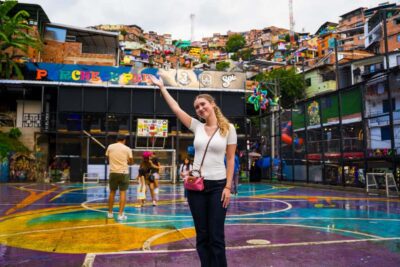
Comuna 13 Tour with Snacks And Your Own Graffiti
Read our review →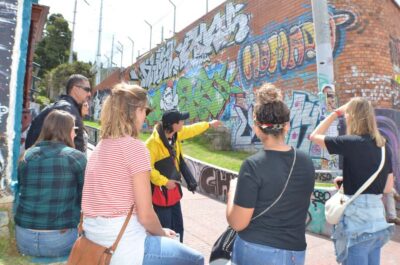
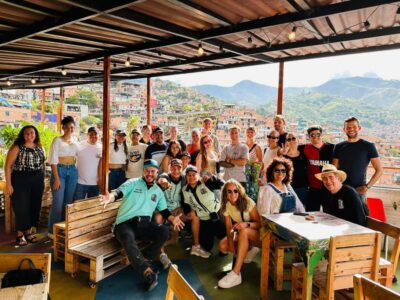
Comuna 13 and Graffiti Guided Tour with a Local
Read our review →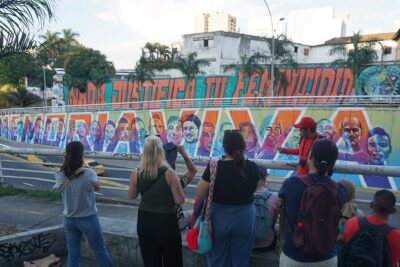
Historical Shared Tour Salsa, Graffiti & Resistance in Cali
Read our review →
Graffiti Tour in La Candelaria Bogotá with Transportation
Read our review →
2-Hours Street Art Walking Tour in Medellin Comuna 13
Read our review →Browse the lists this tour appears in